



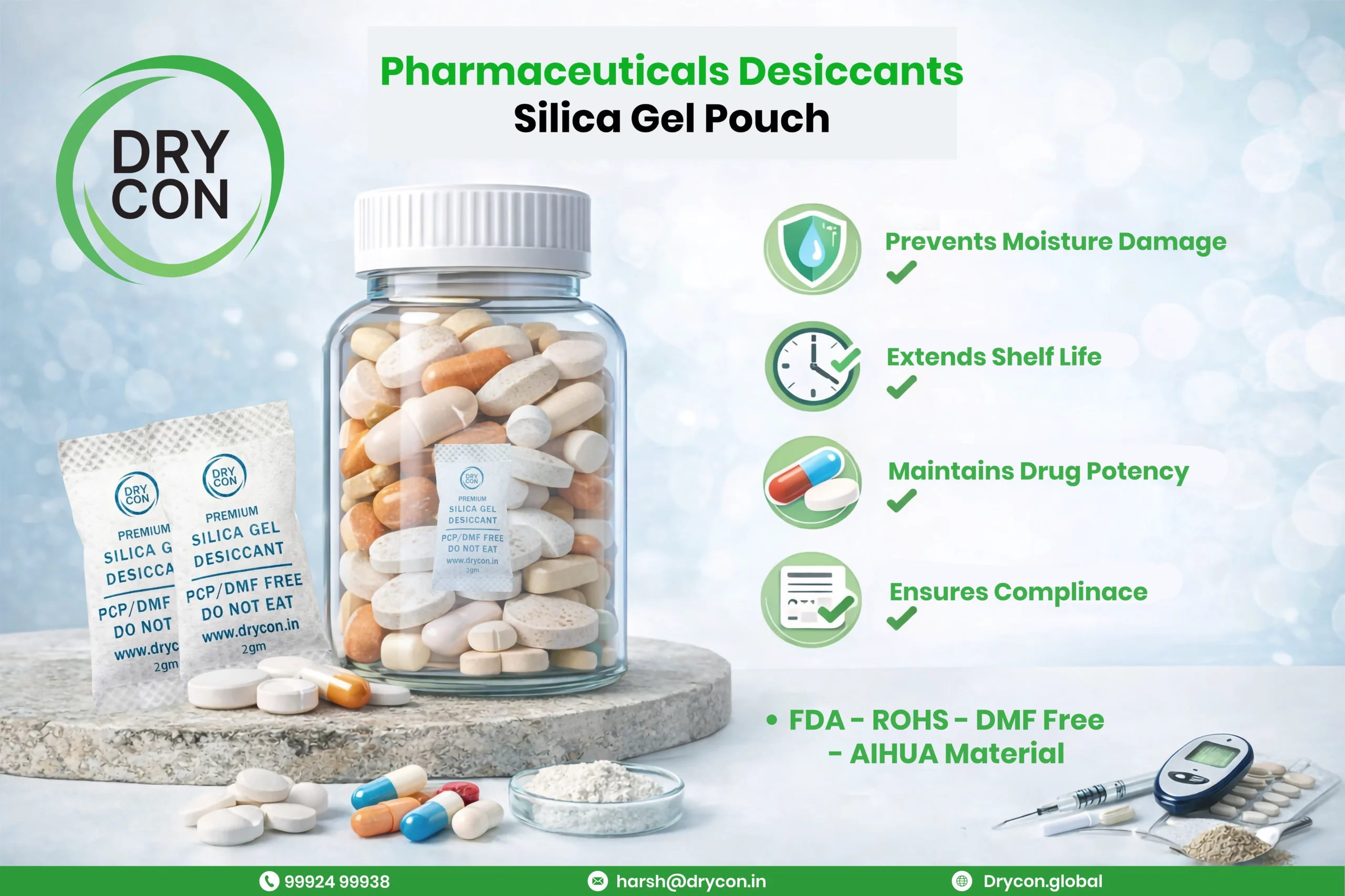
Pharmaceutical packaging contains an essential risk through moisture ingress, which people often fail to recognize properly. Hydrolysis occurs because even small humidity levels inside sealed bottles or blister cavities or HDPE containers, result in hydrolysis, which causes tablet and capsule physical damage. The understanding of desiccants advantages in pharmaceutical applications through pharmaceutical formulation experts and packaging design experts and quality assurance professionals and regulatory specialists requires everyone to understand their advantages. In these blog let’s understand in-depth benefits of desiccants in pharmaceuticals for drug safety.
Desiccants function as advanced systems which control moisture through their ability to create specific environmental conditions inside package headspace. The article demonstrates how desiccants preserve pharmaceutical products by explaining their protective function and their ability to maintain drug stability and their essential role in pharmaceutical packaging system protection against moisture throughout the complete distribution network.
Why Moisture Control Is Non-Negotiable in Pharma Packaging
The majority of solid oral dosage forms exhibit hygroscopic properties which vary in their degree. The API and excipient materials can absorb atmospheric moisture, which results in three different consequences:
- Active ingredient destruction through hydrolytic degradation
- Dissolution performance decrease
- Tablets can expand, break, or develop lamination and capping problems
- Capsule shells experience softening and permanent shape changes
- Microbial contamination risk increases when these factors occur
The need to safeguard medicines from moisture damage during packaging operations and stability assessment processes stands as the most critical packaging requirement.
How Desiccants Protect Pharmaceutical Products Inside Sealed Packs?
The method which desiccants use to safeguard pharmaceutical products through sealed packaging requires an examination of package headspace. Sealing a bottle or blister results in the retention of leftover humidity which becomes trapped inside. The combined effect of temperature changes during storage and transportation leads to the formation of condensation.
The proper desiccant selection for medicine packaging functions by capturing all existing moisture while keeping building humidity levels inside the package at safe levels which helps protect the product throughout its entire shelf life.
The fundamental method which controls moisture content in pharmaceutical packaging procedures delivers this outcome.
1. Preserves API Integrity and Drug Potency
The main role of desiccants in drug stability involves their work to stop hydrolysis as well as moisture-based degradation processes. The low-humidity microenvironment created by desiccants enables them to protect API structure and potency from the point of manufacturing until it reaches patients.
The use of desiccants in pharmaceuticals provides this major advantage.
2. Extends Shelf Life of Tablets and Capsules
The environmental humidity level affects solid dosage forms because their production process requires precise humidity control. The use of desiccants during tablet and capsule storage prevents tablets from taking in moisture which would change their hardness and friability and dissolution properties.
The product directly confirms its shelf life through the results found in stability tests which studied its actual shelf life duration.
3. Enables Reliable Pharmaceutical Packaging Moisture Protection
The moisture vapor transmission rates of HDPE packaging materials which include bottles and caps and induction seals and blister films have specific values which manufacturers follow. Desiccants function as a protective element which improves the ability of pharmaceutical packaging to prevent moisture from entering through the pack’s existing barrier system.
Also Read : DryCon Bag vs Traditional Desiccants for Cargo Protection
4. Prevents Moisture Damage in Medicines During Transportation
The process of temperature cycling during shipping creates conditions which result in internal condensation formation. The use of desiccants creates a method which protects medicines from moisture damage during medicine storage.
The dedicated desiccant which pharmaceutical applications require absorbs all temporary moisture which will impact the dosage form.
5. Maintains Physical Integrity of Dosage Forms
Moisture exposure can lead to:
- Tablet chipping and cracking
- Capsule shell distortion
- Powder clumping in sachets
Desiccants for tablet and capsule storage prevent such physical instability, maintaining product appearance and performance.
Also Read : 15 Practical Benefits of Using Oxygen Absorbers in Food Packaging for Long Term Storage
6. Supports Stability Study Compliance and Regulatory Expectations
Regulatory authorities expect pharmaceutical products to remain stable under ICH-recommended storage conditions. The implementation of moisture control through packaging desiccants enables manufacturers to achieve complete stability solution requirements. The established connection between desiccants and drug stability maintains its validity through the validation process.
7. Reduces Microbial Growth Risk
The presence of moisture creates conditions which enable microbes to multiply, particularly in nutraceuticals and herbal products. The application of desiccants to prevent moisture damage for medicines leads to a major decrease in the risk of contamination.
8. Essential for Hygroscopic and Moisture-Sensitive Formulations
The specific APIs and excipients show fast moisture absorption properties. The selection of appropriate desiccants for pharmaceutical use becomes essential to protect these formulations from rapid degradation.
9. Improves Reliability of Bottle, Blister, and Container Packaging
Different pack formats require tailored solutions. The high adsorption capacity of silica gel desiccants makes them suitable for pharmaceutical packaging because they maintain their chemical structure when used in bottles and canisters.
They function as a reliable desiccant solution which medical packaging requires.
10. Critical for Pharma Distribution in Humid Regions
In tropical climates, ambient humidity can be extremely high. The active ingredients of desiccants function as a protective barrier which helps pharmaceutical packages protect against moisture damage under extreme climatic conditions.
11. Cost-Effective Protection Against Batch Rejection and Recalls
The stability failures which result in financial losses create an affordable solution through the employment of desiccants. The use of desiccants in pharmaceuticals brings practical advantages which enhance the total value they offer to the industry.
Also Read : 8 Essential Roles of Silica Gel Packets in Packaging for Moisture Control
Types of Desiccants Used in Pharmaceuticals
The proper selection of desiccants for pharmaceutical applications requires knowledge about their different types.
- Silica gel: The material serves as a pharmaceutical packaging desiccant because of its highly porous structure and chemical inertness and widespread usage as silica gel desiccants.
- Molecular sieves: The technology creates pores with exact dimensions which enable operators to maintain extremely low atmospheric moisture levels.
- Clay Desiccants: The natural form of clay desiccants provides budget-friendly solutions which deliver basic protection for moderate needs.
The pharmaceutical industry selects its desiccants based on three factors which include the expected moisture content and the size of packaging materials and the sensitivity of products to environmental changes.
Designing Effective Moisture Control in Pharma Packaging
The packaging manufacturers need to assess two factors which include their bottle capacity and the space above the liquid. The packaging material’s moisture vapor transmission rate determines the packaging system’s capability to maintain proper moisture conditions during distribution.
The anticipated storage conditions create a requirement to maintain the hygroscopic characteristics of the formulation. The process requires correct desiccant sizing and placement. The systematic method demonstrates how desiccants safeguard pharmaceutical products throughout the entire process of their real-world protection.
Also Read : Desiccant Quantity Calculation Guide for Export Packaging