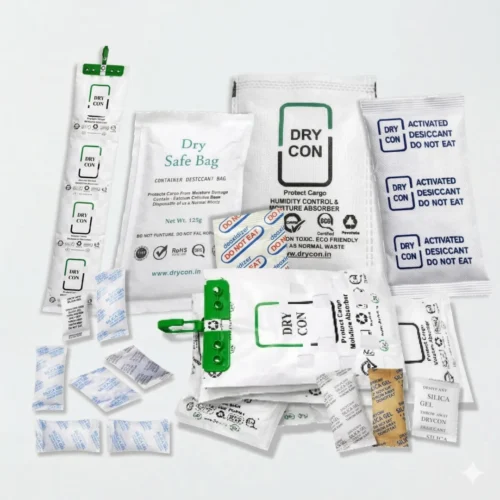




Desiccant quantity calculation should never be based on guess work, or that kind of standard “one sachet per box” thing. Also, in manufacturing environments, the actual desiccant requirement depends on more than just package volume, like really. Packaging material type, residual moisture inside the product, storage duration, shipping route, temperature oscillations, and humidity exposure all play a role in how much moisture absorber capacity is required in practice.
At Drycon, we tend to see that customers look mostly at the size of the package, while the real problem is moisture that sneaks in through the packaging materials or that gets released from the product itself. Getting a handle on these factors is pretty much essential, if you want dependable packaging moisture control.
The Hidden Factors That Influence Desiccant Quantity Calculation
Many online calculators simplify the process by looking only at package dimensions. In practice, that approach rarely produces accurate results.
The total moisture load inside a package comes from several sources:
- Moisture trapped during packing.
- Moisture contained within the product.
- Moisture released by corrugated cartons and paper inserts.
- Water vapor permeating through packaging films.
- Condensation caused by temperature changes during transport.
- Long-term storage conditions.
A desiccant for packaging must absorb all these moisture sources while maintaining the desired humidity level throughout the intended shelf life.
This is why packaging engineers normally evaluate moisture balance rather than package volume alone.
Understanding Moisture Sources Inside a Package
1. Residual Moisture in Products
Many materials naturally contain water.
Examples include:
Product Type |
Moisture Contribution / Sensitivity |
|---|---|
| Leather Goods | Moderate to High |
| Pharmaceutical Powders | Sensitive to Trace Moisture |
| Electronic Components | Very Low Moisture Tolerance |
| Nutraceutical Products | Moderate |
| Textile Products | High |
| Food Ingredients | Product-Dependent |
A typical mistake among exporters is assuming that dry-looking products are moisture-free.
From a factory perspective, products leaving production lines often retain moisture equilibrium with surrounding air. If packaging takes place at 65% RH, the product itself may already contain enough moisture to affect long-term stability.
2. Packaging Materials Can Become Moisture Sources
This is one observation many distributors never discuss.
Corrugated cartons, kraft dividers, instruction manuals, labels, and paper inserts contain moisture.
In humid climates, these materials absorb water before packing.
Later, during transportation, they release that moisture into the sealed package.
In export applications, the packaging structure itself sometimes contributes more moisture than the product.
Because of this, quality-conscious manufacturers evaluate:
- Carton grammage
- Paper content
- Fiber density
- Initial moisture level
- Storage conditions before packing
These factors directly influence the correct desiccant quantity for cartons.
3. Moisture Permeation Through Packaging Films
No flexible packaging film is completely impermeable.
Water vapor transmission rates (WVTR) vary significantly:
Packaging Material |
Relative Moisture Barrier |
|---|---|
| LDPE (Low-Density Polyethylene) | Moderate |
| HDPE (High-Density Polyethylene) | Moderate |
| PET (Polyethylene Terephthalate) | Good |
| Aluminum Foil Laminate | Excellent |
| Nylon Structures | Good |
| Paper Laminates | Low |
A common misconception is that thicker films automatically give better humidity control packaging, but honestly that seems kind of too easy. Material selection often matters more than the thickness itself, and that part people skip. For instance, a thin foil laminate can sometimes outperform a much thicker polyethylene structure, by a fair margin.
How to Calculate Desiccant Quantity for Packaging?
Step 1: Determine Package Volume
Calculate:
Length × Width × Height
Package volume provides an initial estimate but should never be the only factor used in desiccant requirement calculation.
Step 2: Evaluate Product Sensitivity
Ask:
- Is the product hygroscopic?
- Can it oxidize?
- Is corrosion possible?
- Are labels affected by humidity?
- Does microbial growth create risks?
Different products require different equilibrium humidity levels.
Step 3: Consider Storage Duration
Storage periods influence silica gel quantity for packaging.
Approximate examples:
Storage Period |
Moisture Exposure Risk |
|---|---|
| Less Than 1 Month | Low |
| 3–6 Months | Moderate |
| 6–12 Months | High |
| More Than 1 Year | Very High |
Longer storage demands higher adsorption capacity.
Step 4: Analyze Shipping Conditions
For export packaging desiccant applications, shipping routes matter.
Important questions include:
- Will products cross tropical regions?
- Will containers experience day-night temperature cycling?
- Is ocean transportation involved?
- Will products remain in customs warehouses?
Container walls often become cooler than surrounding air. This creates condensation, sometimes referred to as container rain. Moisture control for shipping containers must account for these conditions.
Also Read : AIHUA vs Standard Silica Gel Packaging: Which is Safer for Food & Pharmaceuticals?
Desiccant Size Calculation Based on Moisture Load
Instead of simply asking, “How much desiccant do I need?” packaging engineers usually ask, “How much moisture must the desiccant remove?” This approach produces more reliable results.
Factors influencing desiccant size calculation include:
- Product moisture content.
- Relative humidity during packing.
- Target shelf life.
- Water vapor transmission rate.
- Packaging material.
- Temperature profile.
- Distribution route.
For critical applications, adsorption calculations are performed using moisture sorption curves rather than package dimensions alone.
Desiccant Sachet Size Guide
Common sachet sizes include:
Sachet Size |
Typical Applications |
|---|---|
| 0.5 g | Diagnostic Kits and Medical Devices |
| 1 g | Electronic Components and Small Devices |
| 2 g | Small Pharmaceutical Packs |
| 5 g | Consumer Goods and Retail Packaging |
| 10 g | Industrial Packaging Applications |
| 25 g | Bulk Cartons and Storage Containers |
| 50 g | Export Cartons and Shipping Packages |
| 100 g | Large Machinery Parts and Equipment |
| 500 g | Drums, Bulk Packaging, and Industrial Storage |
The best choice depends on adsorption capacity rather than physical dimensions.
Why Bigger Desiccants Are Not Always Better
Oversizing has disadvantages:
1. Increased Cost
More desiccant does not always improve protection.
2. Space Limitations
Large sachets can interfere with packaging operations.
3. Regulatory Issues
Certain industries limit the amount and placement of moisture absorber for packaging.
4. Uneven Moisture Distribution
Multiple smaller sachets often perform better than one large unit.
In pharmaceutical packaging, distributed placement generally produces more uniform humidity control.
Also Read : DryCon Bag vs Traditional Desiccants: A Practical Guide for Exporters and Shippers
Container Desiccant Calculation for Export Applications
Container transport introduces entirely different challenges. Temperature cycling causes moisture migration inside containers. A 40-foot container may experience daily temperature variations exceeding 20°C. Repeated condensation cycles create substantial moisture loads. Container desiccant calculation therefore considers:
- Container size.
- Voyage duration.
- Geographic route.
- Cargo moisture.
- Ventilation.
- Seasonal humidity.
How Much Silica Gel for Container Shipping?
The answer depends heavily on cargo type.
Examples include:
1. Electronics
Need low relative humidity and corrosion protection.
2. Textiles
Require control against mildew and odor formation.
3. Machinery
Need corrosion prevention.
4. Food Products
Require stable humidity without affecting product quality.
5. Pharmaceuticals
Need strict environmental control and regulatory compliance.
In practice, silica gel calculation for export packaging often uses kilogram-level desiccant quantities rather than gram-level sachets.
Also Read : 7 Costly Shipping Problems Solved by Container Desiccant Bags
Correct Desiccant Quantity for Cartons
Carton packaging presents unique challenges. Paperboard absorbs and releases moisture continuously. Important variables include:
- Carton dimensions.
- Board thickness.
- Number of internal partitions.
- Product moisture.
- Shelf life.
- Climatic conditions.
Quality teams frequently underestimate moisture contribution from corrugated materials. In high-humidity regions, carton components themselves can account for a significant portion of the total moisture burden.
Industrial Packaging Moisture Control Requires Material Compatibility
Not all desiccants behave identically.
Silica Gel
Advantages:
- Chemically inert.
- Non-corrosive.
- High adsorption efficiency.
- Stable over wide temperatures.
Suitable for:
- Pharmaceuticals.
- Electronics.
- Food products.
- Medical devices.
Clay Desiccants
Advantages:
- Economical.
Limitations:
- Lower adsorption at low humidity.
Molecular Sieves
Advantages:
- Very low equilibrium humidity.
Used for:
- Critical pharmaceutical applications.
- Specialty electronics.
Calcium Chloride
Advantages:
- Very high moisture absorption.
Limitations:
- Risk of liquid formation.
Not suitable for all packaging configurations. Selecting the wrong desiccant chemistry can create more problems than using insufficient quantities.
Regulatory Considerations in Packaging Moisture Control
Regulatory teams should evaluate:
Pharmaceutical Packaging
Consider:
- USP requirements.
- DMF documentation.
- Material traceability.
- Stability studies.
Food Packaging
Evaluate:
- FDA compliance.
- EU food-contact requirements.
- Migration studies.
Medical Devices
Review:
- ISO 11607.
- Packaging validation.
- Shelf-life studies.
Electronics
Follow:
- JEDEC moisture sensitivity standards.
Desiccant quantity guide for exporters should always align with applicable regulatory frameworks.
Why Manufacturing Quality Matters More Than Many Buyers Realize
Two 5g silica gel sachets may not deliver the same adsorption performance.
Differences arise from:
- Silica gel grade.
- Particle size.
- Moisture content before filling.
- Sachet permeability.
- Heat sealing quality.
- Filling accuracy.
At the factory level, quality control extends beyond checking sachet weight.
Drycon routinely evaluates:
- Adsorption performance.
- Seal integrity.
- Dust generation.
- Leakage resistance.
- Batch traceability.
If the sealing is not really tight, it can let moisture slip into the sachet before it’s used, and then the usable capacity is kind of reduced. This problem is hard to spot visually, but it can end up impacting performance more than anyone would expect.
Questions Every Buyer Should Ask Before Finalizing Desiccant Size
1. What humidity level must be maintained?
Different products tolerate different moisture levels.
2. How long will products remain in storage?
Shelf life affects adsorption requirements.
3. What packaging materials are being used?
Barrier performance varies widely.
4. Are products shipped internationally?
Export routes introduce severe humidity fluctuations.
5. Is condensation expected?
Ocean transport increases risk.
6. Is regulatory compliance required?
Pharmaceutical and food industries have stricter requirements.
7. Is batch traceability available?
Traceability supports investigations and quality assurance.
Insights From Real Production Environments
One common observation from packaging audits is that desiccants are frequently added after cartons have already absorbed moisture from warehouse air. By that point, part of the adsorption capacity is immediately consumed. Better results are achieved when:
- Packaging materials are stored in humidity-controlled areas.
- Products are packed quickly after drying.
- Desiccants are inserted immediately before sealing.
- Exposure time on the line is minimized.
These process controls often improve package performance more than simply increasing desiccant quantity. This is an area where experienced manufacturers and quality teams usually focus their efforts.
Conclusion: Desiccant Quantity Calculation Should Be Based on Moisture Science, Not Guesswork
Effective desiccant quantity calculation involves much more than selecting a sachet size from a chart.
Accurate desiccant requirement calculation requires understanding:
- Product moisture characteristics.
- Packaging material behavior.
- Water vapor transmission.
- Shipping environments.
- Regulatory requirements.
- Storage duration.
- Manufacturing quality.
Whether determining how much desiccant do I need, performing desiccant size calculation, planning container desiccant calculation, or selecting the right export packaging desiccant, the objective remains the same: maintaining stable humidity conditions throughout the product’s life cycle.
From a manufacturing perspective, successful packaging moisture control comes from balancing adsorption capacity with package design and process discipline. The right quantity is not necessarily the largest amount. It is the amount required to manage the actual moisture load while preserving product integrity.
That principle is what guides responsible desiccant manufacturers and packaging engineers who treat moisture control as part of product protection rather than as an afterthought.