



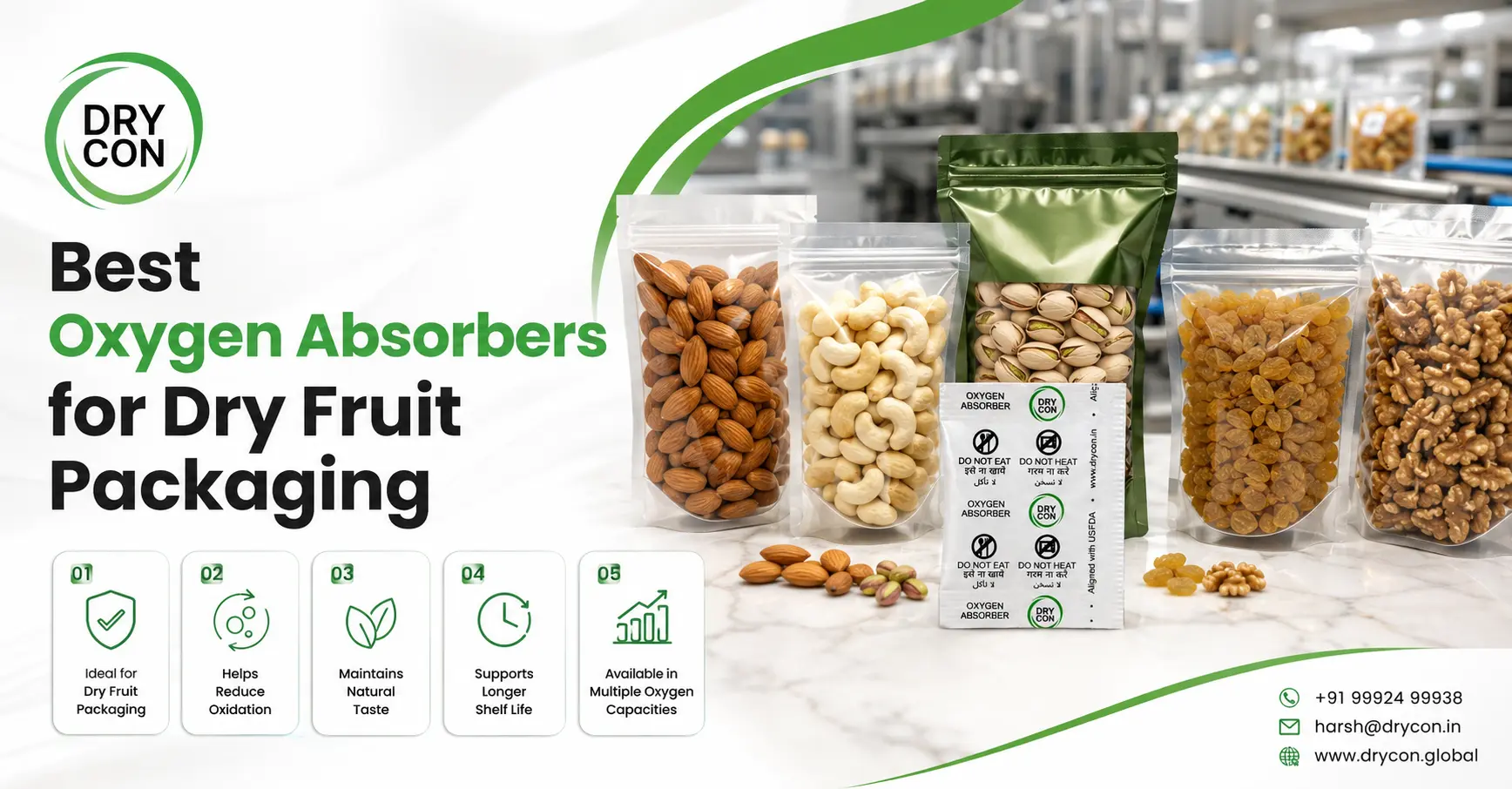
Dry fruits can look totally ok when they are packed, and yet, during storage they may slowly lose that nice quality. Oxygen that stays inside the pack can trigger oxidation, and then you end up with rancid flavors, odd color shifts, and a general fading of aroma. So oxygen absorbers for dry fruit packaging are used a lot by exporters and packaging teams who want more control over product quality.
Still, picking an absorber is not the same as grabbing a packet with a bigger capacity. The right fit depends on pack volume, how much residual air is still sitting there, the barrier level of the packaging, the kind of dry fruit, the sealing process too, and honestly how long it’s expected to be stored.
This guide walks you through how to make that call.
Best Oxygen Absorbers for Dry Fruit Packaging
In practice, the best oxygen absorber is the one that actually matches the oxygen load of the final sealed package. Capacity is typically shown as cubic centimeters , or cc, meaning the amount of oxygen the absorber can remove under defined conditions.
For dry fruit use, iron-based Oxygen absorbers are commonly chosen. They work through a reaction with oxygen inside a properly sealed package. After that, they help bring the oxygen level down , creating a low-oxygen atmosphere around the product.
Common capacities include:
- 20cc for smaller packs and lower oxygen loads
- 30cc for medium packs or products needing additional oxygen control
- 50cc for larger packs and higher oxygen loads
- Higher capacities for larger packages or specific commercial applications
The correct size should not be selected only by product weight.
The calculation should consider:
- Internal pack volume
- Product displacement
- Residual air after filling
- Oxygen present in the headspace
- Oxygen transmission through the packaging
- Expected storage and distribution period
- Sealing quality
- Product characteristics
A supplier should help you select capacity based on your actual pack design rather than simply recommending the largest available packet.
The cheapest absorber might not end up being the lowest cost option. An absorber that fails during storage can result in rejected shipments, customer complaints , repacking, product waste, and lost shelf space.
Quick Comparison: Reliable DryCon Manufacturer VS Generic Supplier
Feature |
Reliable DryCon Manufacturer |
Generic Supplier |
| Oxygen capacity | Clearly stated and specified | May be unclear |
| Product consistency | Controlled across batches | Can vary |
| Technical documentation | Available for evaluation | Often limited |
| Batch traceability | Clear production identification | May be missing |
| Packaging material | Defined barrier structure | May be not disclosed |
| Food-contact information | Available where applicable | Often incomplete |
| Application guidance | Based on packed conditions | Usually generic |
| Quality testing | Defined testing process | May be not documented |
| Supply planning | Better support for repeat orders | Depends on stock |
| Technical support | Helps with product selection | Often focused on price |
How Oxygen Absorbers Preserve Dry Fruits?
Oxygen absorbers for dried fruits are made to knock down the oxygen that’s left inside a sealed package. Iron-based systems run an oxidation reaction that, in a sense, uses up the available oxygen.
That part matters because a lot of dry fruits still keep natural oils and fats. Over time those parts can do their own oxidizing, even if nothing else seems to happen. The end result is often a rancid taste , a flat aroma, and overall shifts in product quality.
Also, managing oxygen can help lessen the conditions that allow certain kinds of oxidation and aerobic microbial activity to keep going. But an oxygen absorber is not some kind of replacement for good hygiene, correct drying, or verified food safety controls.
For packaged dry fruits the overall workflow is usually, as follows:
- The dry fruit is packed into a suitable high-barrier package.
- An oxygen absorber is placed inside the package.
- The package is sealed correctly.
- The absorber reacts with oxygen remaining inside.
- The internal oxygen level is reduced.
- The package maintains a lower-oxygen environment if the barrier remains effective.
This is why oxygen control packaging should be viewed as a complete system. The absorber, package, sealing process, filling operation, and storage conditions all affect the final result.
Also Read : Oxygen Absorbers for Bakery Packaging: Complete Buying Guide
Oxygen Absorbers for Almonds and Cashews
Almonds and cashews are good examples of products where oxygen control can matter. Both contain fats that can undergo oxidation during storage. The risk becomes more important when products are:
- Stored for long periods
- Packed for export
- Sold in premium formats
- Exposed to warm distribution conditions
- Packed in large headspace volumes
- Roasted or processed before packaging
For almonds, cashews, pistachios, walnuts, and kind of similar goods, oxygen absorbers can help keep dry fruit, or snack nuts, fresher for longer if they are teamed up with proper barrier packaging.
That said, the absorber should not be seen as the only “preservation work”, because product moisture, water activity, processing conditions, package integrity, and storage temperature all affect the end quality, and not a little.
One common buyer mistake is picking an absorber purely by the product title, as if the label alone tells the whole story. A 100g almond pack and a 1kg almond pack do not necessarily have the same oxygen requirement.
The package dimensions and internal air volume may differ greatly.
Also Read : Oxygen Absorbers for Spices: Complete Guide for Exporters
Dry Fruit Packaging With Oxygen Absorbers
Effective dry fruit packaging solutions require more than adding an oxygen absorber to any available pouch. The package must provide enough oxygen barrier to prevent excessive oxygen from entering after sealing. Depending on the product and application, packaging structures may include high-barrier laminates or other materials designed for low oxygen transmission.
The packaging team should evaluate:
- Oxygen transmission rate
- Moisture barrier
- Seal strength
- Seal integrity
- Puncture resistance
- Pack format
- Product oil content
- Distribution conditions
One major blunder is just using a regular polybag and then expecting an oxygen absorber to keep everything safe for a long time. In practice oxygen can keep creeping in through the packaging material, and because of that the absorber can get used up faster than people usually expect.
The same applies to weak seals. A tiny leak can undermine the entire oxygen control system. For export applications, packaging design should also consider handling, compression, temperature changes, humidity, and long transit periods.

Extending Dry Fruit Shelf Life Naturally
Dry fruit shelf life extension is often discussed as if one technology can solve the entire problem. In practice, shelf life depends on several connected factors.
These include:
- Raw material quality
- Drying and processing conditions
- Moisture content
- Water activity
- Oxygen exposure
- Packaging barrier
- Sealing quality
- Storage temperature
- Light exposure
- Distribution time
Oxygen absorber packets help control one important factor, oxygen. They do not remove moisture from a product. They do not fix poor hygiene. They do not correct high water activity. They also cannot repair a leaking package.
This distinction is important when selecting between different dry fruit storage solutions. A strong food preservation packaging strategy often combines:
Good product preparation + suitable barrier packaging + correct oxygen absorber + controlled storage
This approach gives manufacturers better control than relying on a single packaging component.
Also Read : How to Choose an Oxygen Absorber Manufacturer (Buyer’s Guide)
Oxygen Absorbers for Packaged Nuts and Dried Fruits
Product |
Main Quality Concern |
Potential Role Of Oxygen Control |
| Almonds | Oxidation and rancidity | Helps reduce oxygen exposure |
| Cashews | Oxidation and flavor change | Supports quality retention |
| Walnuts | High oil content | Often limited |
| Pistachios | Flavor and color stability | Useful for oxidation control |
| Raisins | Moisture and oxidation | Can reduce oxygen exposure |
| Dates | Moisture and microbial stability | Depends on product condition |
| Dried Berries | Color oxidation | Protect sensitive quality attributes |
| Mixed Nuts | Different oil levels | Requires careful capacity selection |
Not every dried fruit needs the same packaging approach.
For example, a high-fat nut mix may have a stronger need for oxygen control than a low-fat dried fruit product. At the same time, dried fruits with higher moisture sensitivity may need stronger moisture management.
This is where oxygen absorbers for dry fruit packaging should be selected as part of a product-specific packaging study.
Oxygen Absorbers and Desiccants Are Not the Same
A frequent procurement error is treating oxygen absorbers and desiccants as interchangeable. They solve different problems.
Oxygen absorbers lower the amount of oxygen inside a sealed bag, so in a way the air is a bit less reactive over time. Desiccants on the other hand take in moisture and they help keep humidity stable or at least within a good range.
For example, an oxygen absorber is usually a better fit when oxidation is the main threat, like mostly. A desiccant might feel more appropriate if the key issue is moisture, from the start, or when humidity control is the top concern.
Some products may call for one solution, while others need a carefully evaluated mix, all together. Using both without understanding the product can also create unnecessary cost.
The correct decision should come from the actual failure mode you are trying to prevent.
Food-Grade Oxygen Absorbers for Dry Fruits
Food-grade oxygen absorbers should be evaluated carefully before purchase. The phrase “food grade” alone is not enough for a procurement decision. Ask suppliers for information relevant to your application, including:
- Product specification sheet
- Oxygen absorption capacity
- Packaging material details
- Food-contact compliance information
- Storage conditions
- Shelf life
- Batch identification
- Quality testing records
- Recommended application
- Handling instructions
The sachet itself is not intended to be eaten. It must remain intact during packing, handling, and distribution. For exporters, documentation should be reviewed against the destination market’s requirements. A supplier’s general compliance statement does not automatically cover every country’s import rules.
Preventing Rancidity in Dry Fruits With Oxygen Absorbers
Rancidity is one of the biggest reasons why oxygen control really matters for nuts and those oily dry fruits. Basically, oxidation happens when oxygen reacts with the more susceptible components inside food, especially fats and oils, and you can end up with all these little changes.
Over time it builds up, and then unwanted flavors and also odd odors show up. Oxygen absorbers help by reducing the oxygen available for these reactions. However, the result depends on the entire packaging system.
A good oxygen control setup should address:
- The oxygen already present in the package.
- Oxygen entering through the packaging material.
- Oxygen entering through poor seals or leaks.
- Oxygen exposure during packing and handling.
This is why the absorber’s capacity must match the package.
Why Manufacturer Selection Matters?
The oxygen absorber is a small component. Its impact on product quality can be much larger than its physical size suggests. For procurement teams, supplier selection should therefore focus on consistency, technical support, and documentation.
A reliable supplier should be able to discuss:
- Capacity selection
- Packaging compatibility
- Product handling
- Storage conditions
- Batch control
- Testing procedures
- Supply capacity
- Export requirements
This is relevant to buyers who need repeat supply. Consistent production matters because a packaging line should not need to be recalibrated around a product that changes from one batch to another.
Hidden Costs of Poor-Quality Oxygen Absorbers
A low purchase price can hide larger operational costs. Poor performance may result in:
- Rancid product complaints
- Rejected export consignments
- Shorter usable shelf life
- Product returns
- Repacking expenses
- Production downtime
- Extra quality inspections
- Loss of customer confidence
For this reason, procurement should compare the total cost of protection, not only the cost per sachet.
Also Read : Foods That Need Oxygen Absorbers (and Foods to Avoid)
How to Choose the Right Oxygen Absorber?
Before placing a bulk order, ask these questions:
- What is the final package volume?
- How much headspace remains after filling?
- What is the packaging material?
- What is its oxygen barrier?
- What is the expected shelf life?
- How long will the product be in transit?
- Is the product exported?
- What is the expected storage temperature?
- Does the product contain significant oil or fat?
- How quickly can the package be sealed after opening the absorber master pack?
- What capacity does the supplier recommend?
- Can the supplier support product validation?
For large production runs, conduct a packaging trial before full-scale procurement.
Measure the actual performance of the complete system. This may include residual oxygen testing, seal integrity testing, accelerated storage studies, and sensory evaluation, depending on the product and quality plan. The goal is to validate the system, not simply the absorber.