



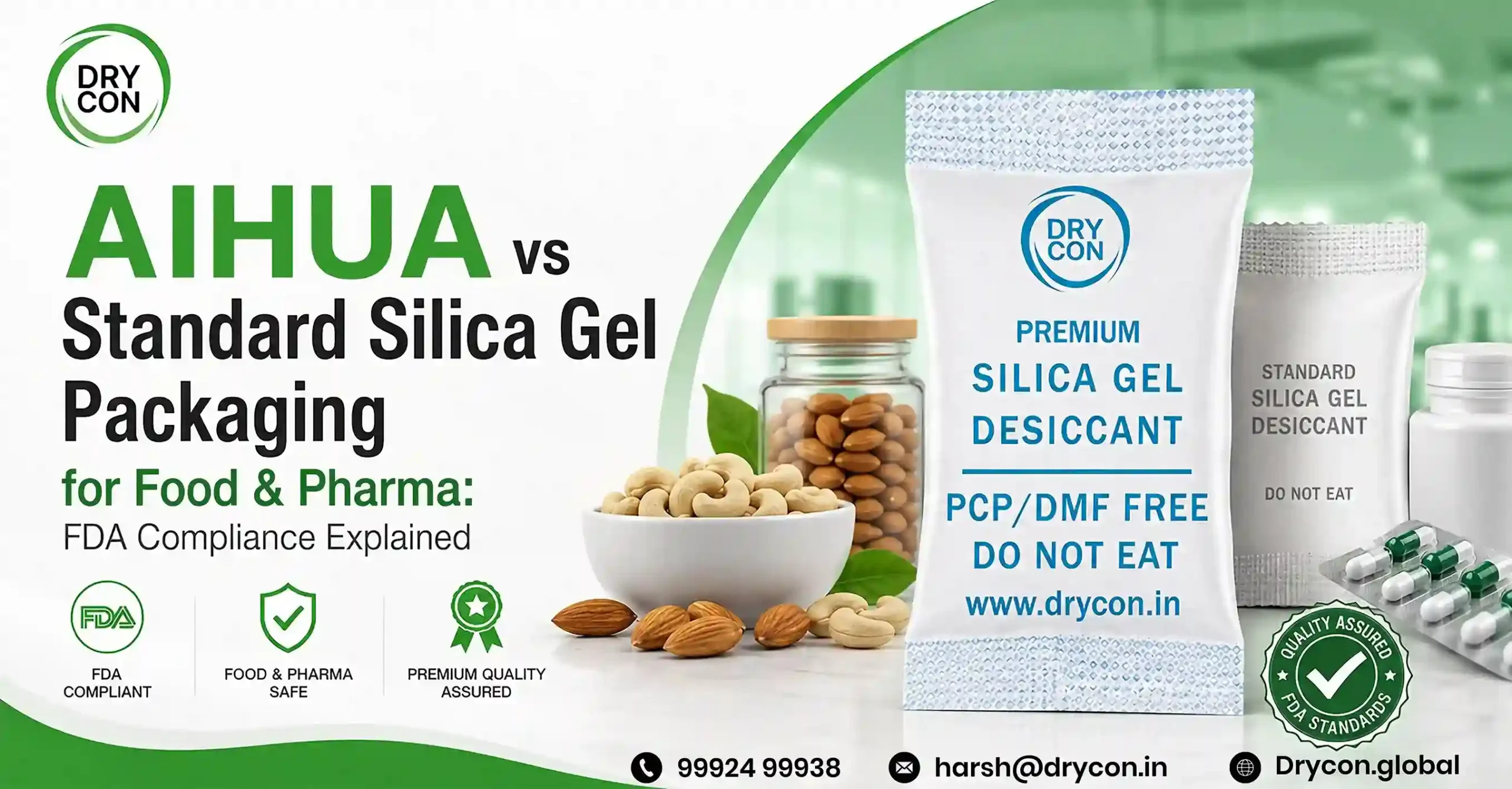
Understanding AIHUA vs Standard Silica Gel Packaging is a big deal when you’re looking at moisture control for specifically food and pharmaceutical use. Usually, when moisture sensitive products end up failing, people think it’s the silica gel, but more often the real issue is the packaging material around it, not the desiccant itself.
In pharma manufacturing, nutraceutical packing, food processing, and export logistics most buyers are kind of stuck on adsorption capacity, how much desiccant you get and the unit cost. But honestly, far fewer of them check the substrate that’s actually holding the silica gel. And still, that packaging material is the one thing that really affects moisture transfer, dust generation, product contamination risk, regulatory requirements, seal strength, and, in the end, shelf life.
So this is why the whole AIHUA vs Standard Silica Gel Packaging conversation matters. From the manufacturing side, two silica gel sachets can both contain the same desiccant grade, but their performance can still swing a lot depending on what packaging substrate gets used.
A sachet that was designed for industrial equipment exports might not be right for direct food contact. And vice versa, the packaging material that seems fine for dry consumer goods may not hit pharmaceutical quality expectations.
As moisture control solution manufacturers, we regularly see procurement teams compare silica gel products mostly by price. Meanwhile packaging engineers, QA managers, and regulatory teams tend to look deeper, because substrate selection can decide whether the desiccant solution actually supports compliance, product safety, and long term stability.
This article breaks down the technical differences between AIHUA packaging materials and conventional silica gel sachet materials, goes into FDA related points, and explains how packaging decisions shape pharmaceutical and food applications.
Understanding AIHUA Silica Gel Packaging
What Is AIHUA Packaging?
AIHUA packaging is uses a specialized desiccant sachet material, engineered for high performance moisture control situations where cleanliness, strength, breathability, and regulatory compliance really matter.
Compared with usual paper style sachets, AIHUA material is generally made with multilayer synthetic layers, so you get:
- Controlled moisture permeability
- Low particle migration
- Superior seal strength
- Enhanced resistance to tearing
- Better performance in automated packaging environments
The idea of AIHUA is that the film and layers are set up so water vapor molecules can travel into the silica gel, but desiccant particles and dust are kept inside. That sort of tight balance between vapor access and containment is one of the major reasons pharmaceutical companies increasingly choose AIHUA based packaging.
AIHUA vs Standard Silica Gel Packaging: The Real Engineering Differences
Feature |
AIHUA Packaging |
Standard Packaging |
|---|---|---|
| Moisture Vapor Transmission | Controlled and Consistent | Can Vary by Material Quality |
| Dust & Particle Leakage | Very Low | Moderate to High |
| Fiber Shedding | Minimal | Possible, Especially with Paper-Based Materials |
| Moisture Adsorption Efficiency | High and Predictable | Inconsistent |
| Seal Strength | Excellent | Moderate |
| Tear Resistance | High | Moderate |
| Puncture Resistance | High | Moderate |
| Product Contamination Risk | Low | Higher Compared to AIHUA |
| Pharmaceutical Suitability | Excellent | Application-Dependent |
| Food Industry Suitability | Excellent | Depends on Material Compliance |
| Performance in Automated Packaging | Highly Reliable | Highly Variable |
| Shelf-Life Protection | Superior | Standard |
Why Packaging Material Matters?
Silica gel works by catching or sticking moisture from wherever it is, sort of the environment around it. But the water, or any humid air, has to get past the packaging backing first, before it can really get to the desiccant.
When the packaging material limits vapor movement too much, the ability to adsorb that moisture becomes lower, like less effective overall. On the other hand, if permeability is overly high, you may lose some physical shielding, and also contamination management might not hold up as well.
Therefore, effective desiccant packaging must balance:
- Vapor transmission
- Particle retention
- Mechanical strength
- Regulatory compliance
- Manufacturing consistency
This is where significant differences emerge between AIHUA and conventional packaging materials.
Also Read : How To Choose The Right Desiccant Types for Smart Packaging Decisions?
Dust Generation and Contamination Control
One of the biggest worries in food, and also in pharma manufacturing, is particle contamination. Even if silica gel is generally safe and non toxic, any escaped dust can cause problems during:
- Tablet packaging
- Capsule filling
- Powder packaging
- Spice processing
- Nutraceutical bottling
Standard paper sachets can shed fibers or allow fine particles to migrate under mechanical stress.
AIHUA materials are specifically designed to reduce:
- Fiber shedding
- Dust leakage
- Particle migration
- Surface contamination
This becomes particularly important during high-speed packaging operations where sachets experience repeated impact and vibration. A practical observation from production environments is that dust-related complaints often originate not from desiccant quality but from poor sachet material selection.
Breathability and Moisture Adsorption Efficiency
Many buyers generally assume that thicker packaging automatically means better protection, and it usually sounds logical at first. But in moisture control applications this assumption is often not quite right, because the problem is usually more complicated than just wall depth or stuff like that. Food grade silica gel desiccant packaging must remain breathable.
AIHUA packaging materials are engineered to provide:
- Consistent vapor transmission rates
- Uniform moisture diffusion
- Reliable adsorption performance
Some lower-grade paper materials may become partially blocked by fibers, coatings, or manufacturing inconsistencies. The result is slower moisture transfer and reduced desiccant efficiency.
For products with tight moisture specifications, such as:
- Effervescent tablets
- Probiotics
- Diagnostic kits
- Nutraceutical powders
Even small differences in adsorption efficiency can influence shelf-life outcomes.
Also Read : Silica Gel Pouch vs Oxygen Absorbers: Practical Difference for Packaging Safety
Seal Integrity and Packaging Durability
Seal failure remains one of the most common causes of desiccant packaging defects.
When sachets rupture:
- Silica gel may leak
- Product contamination risks increase
- Batch rejection becomes possible
AIHUA packaging generally demonstrates stronger:
- Heat-seal performance
- Tear resistance
- Puncture resistance
- Mechanical durability
This becomes especially valuable during:
- Automated insertion
- High-speed bottling
- Export transportation
- Bulk pallet handling
Manufacturers frequently conduct seal-strength testing because even minor weaknesses can become significant under shipping conditions.
FDA Compliance and Regulatory Considerations
1. What Buyers Often Misunderstand About FDA Compliance
Many buyers assume that using silica gel automatically means the product is FDA compliant. That is not necessarily true. FDA-related suitability depends on several factors:
- Desiccant composition
- Packaging substrate materials
- Manufacturing controls
- Documentation availability
- Intended application
A FDA compliant silica gel packaging solution requires evaluation of the entire sachet system rather than the desiccant alone.
The packaging material itself must be suitable for food-contact or pharmaceutical-contact environments where applicable.
2. Why FDA Compliance Matters for Silica Gel Packaging for Food Industry?
For companies using silica gel packaging for food industry applications, compliance affects:
- Product safety
- Customer audits
- Export approvals
- Retail acceptance
- Brand protection
Products commonly requiring food grade silica gel desiccant solutions include:
- Spices
- Dry fruits
- Coffee
- Tea
- Nutritional supplements
- Dehydrated foods
- Snack products
In these applications, food safe desiccant packaging helps minimize moisture-related deterioration while supporting quality assurance programs.
3. What are Silica Gel Packaging for Pharmaceutical Industry Compliance Expectations?
The pharmaceutical sector typically applies more stringent expectations than many food applications.
When evaluating silica gel packaging for pharmaceutical industry use, manufacturers often assess:
- Material cleanliness
- Extractables and leachable concerns
- Particle containment
- Documentation traceability
- Batch consistency
A sachet that performs adequately in industrial packaging may not satisfy pharmaceutical quality systems.
For this reason, many pharmaceutical manufacturers increasingly adopt AIHUA-based packaging structures as part of their broader pharmaceutical moisture protection solutions strategy.
Impact on Product Shelf Life
Why Moisture Control Extends Stability?
Tablets
- Reduced hardness
- Discoloration
- Loss of potency
Capsules
- Shell softening
- Sticking
- Deformation
Nutraceuticals
- Ingredient degradation
- Reduced efficacy
Food Products
- Clumping
- Mold growth
- Texture changes
- Flavor deterioration
Effective desiccant packaging for sensitive products helps maintain target moisture levels throughout storage and distribution.
The packaging substrate influences how efficiently moisture reaches the silica gel and therefore directly impacts protection performance.
Application Suitability Across Industries
1. Tablets and Capsules
Pharmaceutical packaging often prioritizes:
- Low dust generation
- Cleanroom compatibility
- Documentation support
- Consistent adsorption performance
AIHUA packaging is frequently selected because of its superior particle containment characteristics.
2. Powders and Nutraceuticals
Powder products can be especially vulnerable to contamination concerns. For nutraceutical applications, packaging engineers commonly prefer low-lint materials to reduce particulate risks.
3. Spices and Dehydrated Foods
For silica gel sachets for food packaging, moisture control is critical to:
- Preserve aroma
- Prevent caking
- Maintain texture
- Improve shelf stability
Both AIHUA and standard solutions may be suitable depending on product sensitivity and compliance requirements.
ally vulnerable to contamination concerns.
For nutraceutical applications, packaging engineers commonly prefer low-lint materials to reduce particulate risks.
Also Read : 15 Practical Benefits of Using Oxygen Absorbers in Food Packaging for Long Term Storage
4. Spices and Dehydrated Foods
For silica gel sachets for food packaging, moisture control is critical to:
- Preserve aroma
- Prevent caking
- Maintain texture
- Improve shelf stability
Both AIHUA and standard solutions may be suitable depending on product sensitivity and compliance requirements.
AIHUA vs Non Woven vs Tyvek & Kraft Paper Packaging
Parameter |
AIHUA Packaging |
Tyvek & Kraft Paper Silica Gel Packaging |
Non-Woven Silica Gel Packaging |
|---|---|---|---|
| FDA Suitability | Excellent when certified materials are used | Good | Application-dependent |
| Dust Generation Risk | Very Low | Low to Moderate | Moderate |
| Material Strength | High | Moderate | Moderate |
| Tear Resistance | Excellent | Good | Fair |
| Breathability | Controlled and Consistent | Good | Variable |
| Moisture Adsorption Efficiency | High and Consistent | Good | Moderate |
| Pharmaceutical Suitability | Excellent | Good | Limited |
| Food Contact Suitability | Excellent | Good | Application-Specific |
| Export Suitability | Excellent | Good | Moderate |
| Shelf-Life Protection | Superior | Good | Acceptable |
| Audit Readiness | High | Moderate | Low to Moderate |
| Batch Consistency | High | Moderate | Variable |
| Packaging Appearance | Premium | Professional | Traditional |
| Cost | Higher | Moderate | Lower |
| High-Humidity Environment Performance | Excellent | Good | Moderate |
Which is the Better Choice: AIHUA vs Standard Silica Gel Packaging?
If your products are low-risk and used in general applications, standard silica gel packaging may still work well.
But if you deal with:
- Food products
- Pharmaceuticals
- Nutraceuticals
- Export shipments
- Moisture-sensitive products
Then AIHUA packaging offers a safer and more reliable long-term solution.
It supports:
- Better hygiene
- Stronger packaging
- FDA-compliant practices
- Improved moisture protection
- Reduced contamination risk
For industries where product quality matters, the right desiccant packaging is not just an accessory. It becomes part of product safety itself.