



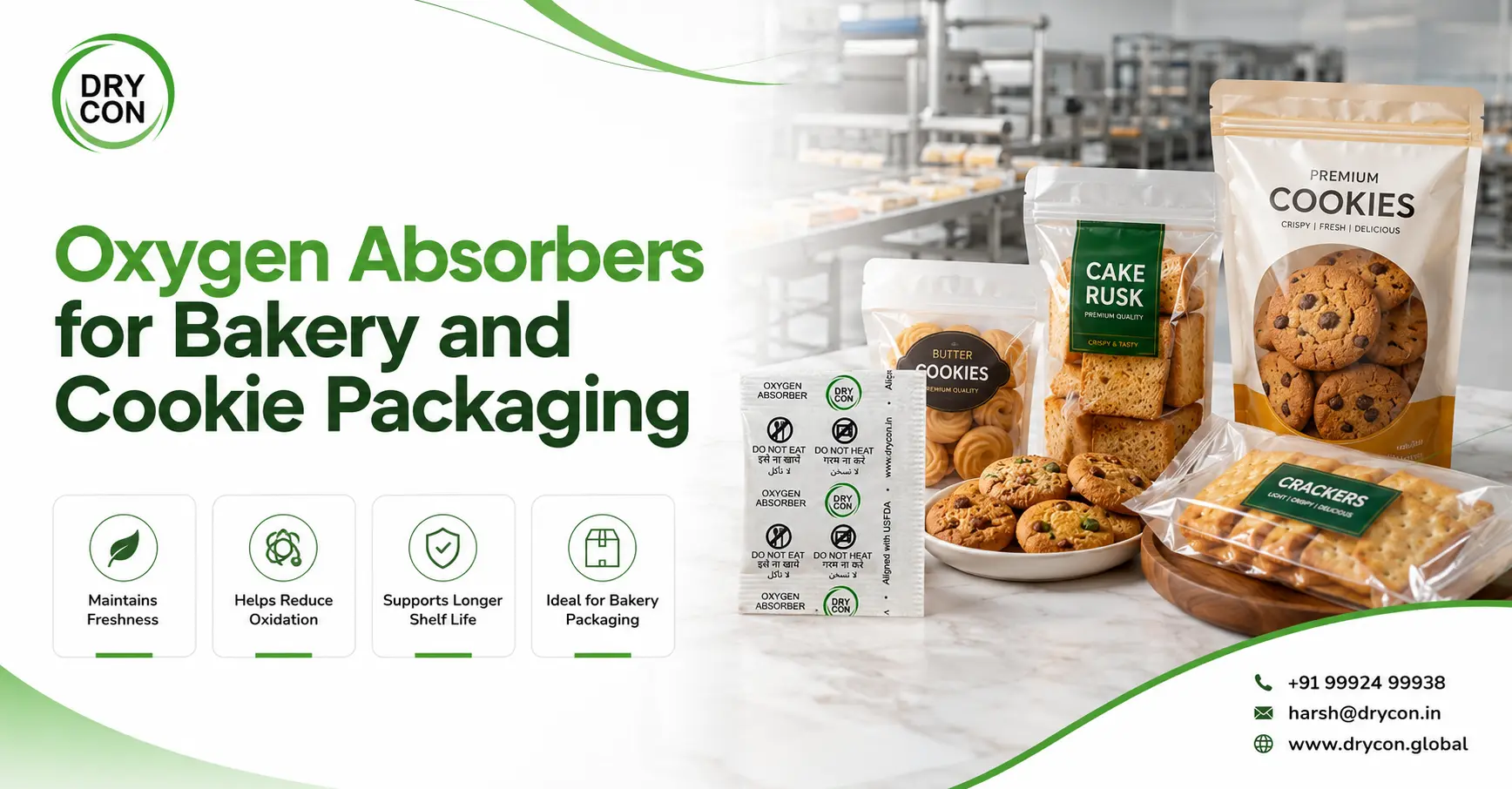
Oxygen Absorbers for Bakery Packaging can help shield baked foods from oxygen driven quality loss, all trough storage, shipping, and export. For makers, the target isn’t just to drop an absorber into a pouch and call it a day. It really has to be the whole packaging system that handles oxygen, also moisture, seal integrity, and the actual storage conditions, at the same time, not separately. Cookies , biscuits, crackers, rusks, and other dry bakery items often seem fine while quality is already slipping. Oxygen can nudge fat oxidation along, push stale flavors, cause color shift, and reduce overall product quality, long before anything obvious happens.
If you use the right oxygen absorber inside a proper high barrier pack, those risks can be lowered pretty well. Still, picking what to buy takes more than choosing a sachet based on price or the pack count. You also need to consider capacity, the packaging volume, residual oxygen, what the product is made of, how good the barrier performs, your production throughput, and the real storage conditions it will face.
This guide goes over how food manufacturers, and the procurement side too, can judge oxygen absorbers for bakery packaging with more confidence, without guessing or hoping.
How Oxygen Absorbers Extend Bakery Product Shelf Life?
An oxygen absorber is a small sachet designed to remove oxygen from a sealed package. Many food-grade oxygen absorbers use iron-based technology. The iron reacts with oxygen and converts it into a stable oxide. This lowers the oxygen level inside the package after sealing.
The result can help slow several oxygen-related quality problems:
- Oxidation of fats and oils
- Development of rancid flavors and odors
- Color changes
- Loss of sensitive nutrients
- Oxidative quality loss
- Growth of some aerobic microorganisms
This is why oxygen absorbers are used as part of shelf life extension for bakery products. However, an absorber does not work alone. It needs a package that limits oxygen entry from outside.
If the packaging film has high oxygen transmission or the heat seal is weak, oxygen can continue entering the pack. That creates a simple rule for packaging teams: An oxygen absorber can remove oxygen inside the pack. The packaging must stop new oxygen from coming back in. This is also why laboratory testing matters.
Manufacturers should test the complete pack, not only the absorber. For bakery products, useful tests may include:
- Residual oxygen measurement
- Oxygen transmission rate of packaging film
- Seal integrity testing
- Shelf-life studies
- Product sensory testing
- Microbiological testing where relevant
The correct shelf life should always be set through product-specific validation. An absorber can help with shelf life extension, but it does not actually lock in a fixed shelf life that applies to every bakery product.
Also Read : Oxygen Absorbers for Spices: Complete Guide for Exporters
Oxygen Absorbers for Packaged Cookies
Cookies are a pretty standard use case for oxygen absorbers, mainly because many have fats, oils, nuts, chocolate, or other oxygen sensitive components. Oxygen can keep reacting with fats over time. That can show up as stale or even rancid notes. In some recipes, oxidation can also shift the aroma and the overall eating quality too.
So Oxygen absorbers for cookie packaging become useful, if you’re planning longer storage, or a longer distribution cycle, where protection matters.
They can be especially relevant for:
- Butter cookies
- Filled cookies
- Nut-based cookies
- Chocolate cookies
- Shortbread
- Premium gift cookies
- Export cookies
- Dry cookies packed for long distribution cycles
However, cookie freshness preservation depends on more than oxygen control. The package must also protect the product from moisture. A cookie that absorbs humidity may lose its crisp texture even when oxygen levels remain low. This is where many packaging decisions go wrong.
A manufacturer may invest in an oxygen absorber but use a weak moisture barrier film. The absorber then controls one problem while humidity creates another. For packaged cookies freshness, the packaging system should therefore consider:
- Oxygen barrier
- Moisture barrier
- Seal strength
- Headspace volume
- Product temperature at packing
- Absorber capacity
- Distribution conditions
The best solution is the one that protects the product against its actual failure modes.
Best Oxygen Absorbers for Bakery Packaging
The correct choice for the best oxygen absorber for bakery packaging depends on the amount of oxygen that must be removed and the conditions inside the final package. Procurement teams should evaluate the following:
Factor |
Why It Matters |
|---|---|
| Absorption Capacity | Must match the oxygen volume inside the package for effective oxygen removal and longer shelf life. |
| Pack Volume | Larger packages or greater headspace require higher-capacity oxygen absorbers. |
| Product Type | Bakery products containing fats and oils are more prone to oxidation and rancidity. |
| Packaging Barrier | High-barrier packaging minimizes oxygen transmission and preserves freshness. |
| Sachet Material | The sachet must allow oxygen transfer while safely containing the active ingredients. |
| Reaction Speed | Fast oxygen absorption helps protect bakery products immediately after sealing. |
| Food-Contact Safety | Always choose food-grade oxygen absorbers that comply with food packaging standards. |
| Batch Consistency | Consistent manufacturing ensures reliable performance across every production batch. |
| Packaging Format | Choose a sachet size that fits the package without affecting product presentation. |
| Storage Life | Store unused oxygen absorbers in airtight packaging to maintain maximum effectiveness. |
DryCon has food-grade oxygen absorbers in capacities including 20CC, 30CC, and 50CC, 100cc with other capacities also shown across its product information. Its website also describes PET/PAP/PE laminated sachet materials and applications across bakery, snacks, spices, and other dry foods.
The key point for buyers is simple: CC capacity should not be selected only from the product weight.
The calculation should consider the total oxygen load in the package. This includes oxygen in the headspace and oxygen that may enter through the packaging system over the intended shelf life.
A technical supplier should be able to explain how the recommended capacity was selected.
Also Read : How to Choose an Oxygen Absorber Manufacturer (Buyer’s Guide)
How to Keep Cookies Fresh Longer?
Keeping cookies fresh requires control of the factors that cause quality loss. For most dry cookies, the main concerns include oxygen, moisture, temperature, light, and physical damage. A practical packaging strategy includes following:
- Start with the right product moisture – The product should enter the package at its intended moisture level. An oxygen absorber cannot correct a cookie that was packed with excess moisture.
- Choose a suitable barrier film – The packaging material should provide the oxygen and moisture barrier required by the product.
- Control the headspace – The more air inside the package, the greater the initial oxygen load.
- Use the correct absorber capacity – The absorber should have enough capacity for the oxygen load and expected oxygen ingress.
- Protect the heat seal – A perfect absorber cannot compensate for a poor seal. Seal contamination, wrinkles, weak sealing temperatures, and incorrect dwell times can allow oxygen and moisture to enter.
- Control storage temperature – Higher temperatures can speed up chemical reactions and also may mess with how stable the product stays. In general, your warehousing and transport conditions should match what was verified in the validated shelf-life study, not something close, like , “sort of similar” because then the results can drift.
- Handle absorbers correctly – Oxygen absorbers start reacting once they get exposed to air, so you really want to keep them in their original sealed packaging until they are needed. If you don’t, they can go into action too soon. For high-volume production, this becomes a process-control issue. The time between opening the master pack and sealing the finished food package should be controlled.
Oxygen Absorbers for Baked Goods Packaging
Oxygen absorbers for baked goods are most useful when oxygen is a major cause of quality loss and the product can be packed in a sufficiently airtight system.
They may be considered for:
- Dry bakery products
- Cookies
- Biscuits
- Crackers
- Rusks
- Dry cakes with suitable formulation
- Bakery snacks
- Long-life baked products
They are generally less suitable for products that release high levels of moisture or require significant oxygen exchange. This distinction matters for buyers.
A supplier should ask questions about the product before recommending an absorber. If the supplier recommends a capacity without understanding the product, package, and storage conditions, the recommendation may be too generic.
Also Read : Foods That Need Oxygen Absorbers (and Foods to Avoid)
What Procurement Teams Should Provide to a Supplier?
Before requesting a quotation, prepare:
- Product name
- Product weight per pack
- Approximate pack dimensions
- Package material
- Headspace volume, if known
- Expected shelf life
- Storage conditions
- Export destination
- Production volume
- Packaging line speed
- Existing oxygen or moisture problems
This information helps the supplier recommend a technically suitable solution.
Preserving Bakery Products During Storage
Storage is where many packaging failures become visible. A product may leave the factory in good condition but lose quality during weeks of warehousing or international transport. Temperature changes can also create pressure changes inside flexible packaging. Poor seals or weak packaging structures may allow air exchange. For exporters, the journey can be even more demanding. Products may experience:
- Long transit times
- Temperature fluctuations
- High humidity
- Extended warehouse storage
- Multiple loading and unloading points
- Different climate zones
This is why baked goods packaging should be designed around the full supply chain. A procurement team should not ask only, “Which oxygen absorber should we buy?” A better question is: “What oxygen control system will protect this product from our factory to the final customer?” This shift in thinking often reveals hidden costs. A low-cost absorber may become expensive if it causes:
- Product returns
- Rancidity complaints
- Shortened shelf life
- Export rejection
- Repacking
- Production downtime
- Customer dissatisfaction
The lowest unit price is rarely the same as the lowest total packaging cost.
Oxygen Absorbers for Biscuits and Crackers
Biscuits and crackers are often a good match for oxygen absorbers, especially in bakery packaging. This is even more true when they have fats or oils and are meant for longer shelf life. Still, their key quality issues tend to be oxidation, plus moisture pickup. So oxygen absorbers for biscuits and crackers should really be chosen together with a proper moisture barrier, not just one thing alone.
For crisp items, moisture management is absolutely critical. Even a small rise in moisture can mess with the texture and, well, lower the whole eating experience. That ends up creating two different aims of protection.
- Oxygen control: helps slow oxidation based spoilage.
- Moisture control: helps keep crispness and texture where it should stay.
Some packaging setups can use desiccants as a companion, however they do not swap in for oxygen absorbers. The same idea works the other way too, an oxygen absorber does not function as a desiccant, it’s not there for that.
The correct combination depends on the product and package. For manufacturers, this is a useful quality question: What is the first failure mode we need to prevent? If the answer is rancidity or oxidative flavor loss, oxygen control may be the priority. If the answer is loss of crispness from humidity, moisture control consultation should be more important. If both occur, the packaging system may need both technologies.
Food Packaging Solutions for Bakery Products
Good bakery packaging solutions start with the product, not the packaging accessory. A technical packaging review should consider five connected elements:
Product → Package → Absorber → Process → Storage
Changing one element can affect the others. For example, moving from a small pouch to a larger family pack increases headspace. This may change the required oxygen absorber capacity.
Changing the film structure can also change oxygen ingress. A package with a stronger barrier may require a different absorber strategy than a package with higher oxygen transmission.
The production process matters too. If absorbers are exposed to air for too long before sealing, their active capacity may begin to reduce before they reach the final package.
Checklist Before Choosing an Oxygen Absorber Manufacturer
Before placing a bulk order, procurement teams should check:
- Is the oxygen absorption capacity clearly defined?
- Can the supplier provide current technical documentation?
- Is batch traceability available?
- Are quality checks performed on production batches?
- Is the sachet suitable for the intended food application?
- Can the supplier explain storage and handling requirements?
- Does the supplier understand your packaging material?
- Can they support trials before full-scale procurement?
- Can they maintain consistent supply for your production volume?
- Can they support export or regulatory documentation where required?
For larger manufacturers, add one more question: Can the supplier support your capacity planning when production volumes increase?
A good supplier relationship should survive growth. Changing absorber suppliers every time your production volume increases can create unnecessary validation work.
Also Read : Benefits of Oxygen Absorber in Food Packaging: 15 Powerful Uses
Red Flags When Buying Oxygen Absorbers
Be careful if a supplier:
- Cannot clearly state the absorber capacity
- Uses inconsistent product specifications
- Provides unclear or incomplete technical documentation
- Cannot explain how the recommended capacity was selected
- Has no batch traceability
- Offers pricing that seems unrealistically low without explaining the specification
- Makes broad shelf-life promises without product testing
- Cannot explain storage requirements
- Has inconsistent sachet dimensions or packaging
- Avoids providing samples for technical evaluation
Unrealistic pricing always deserves special attention. The price of an oxygen absorber is pretty small compared with the worth of the food it actually protects. A tiny saving per sachet, can turn into a large loss if the product quality doesn’t hold up during export, or in long term storage.