



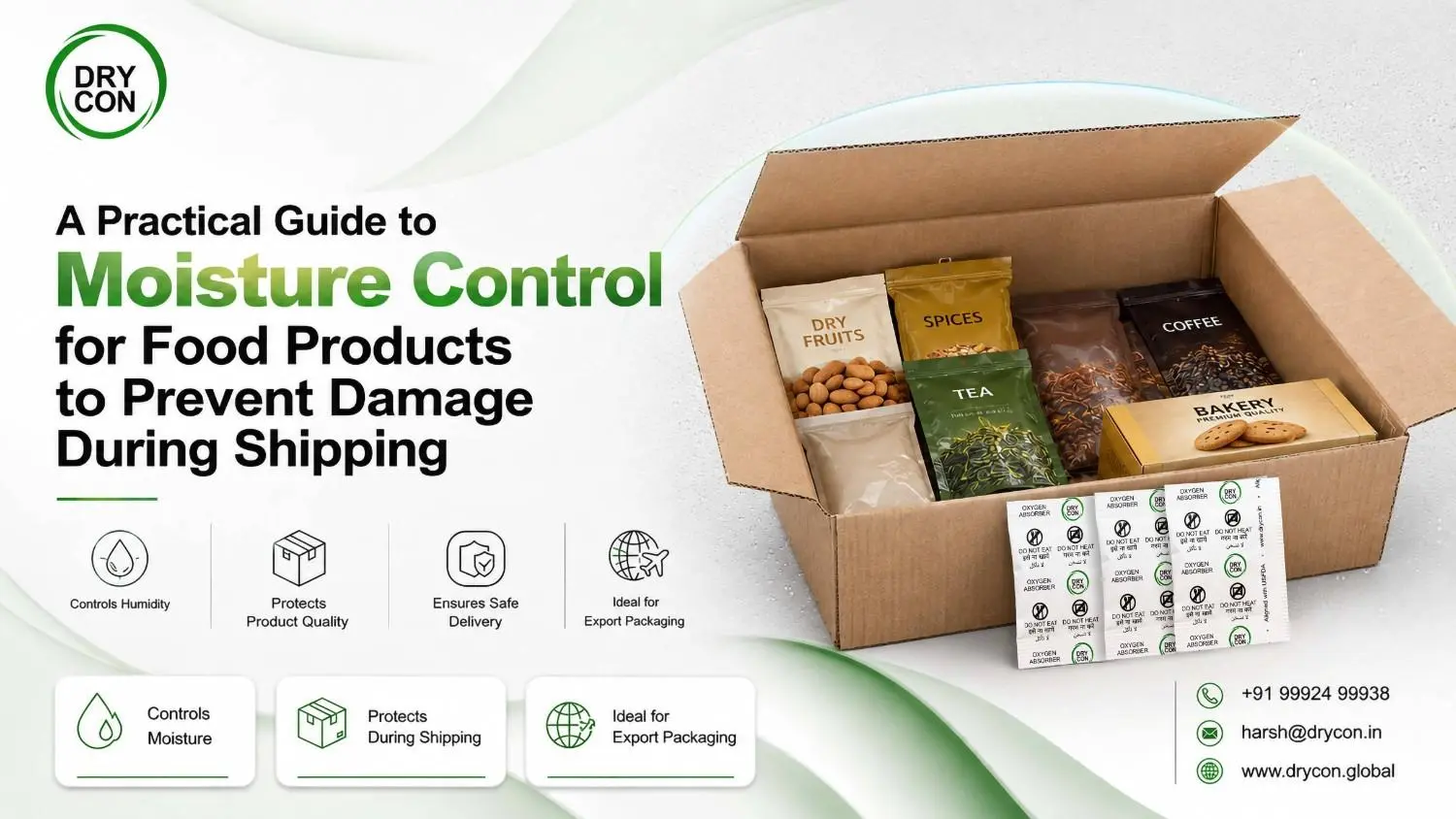
Food manufacturers and exporters usually worry about product quality, until the shipment actually leaves the plant. But moisture control for food products has to keep going during storage and shipping too, because humidity and temperature shifts can slowly stress food, the packaging materials, and even the shelf life before the cargo finally shows up.
You might notice it as the snack goes stale, a dry item can lose that crunch. Spices may clump up and feel uneven, dehydrated fruits can start pulling in water. Even cartons can start to weaken, labels might loosen and peel. And in worse situations, extra moisture can create the right kind of environment for mold to grow, and then you get food spoilage.
It also becomes a real cost problem when the shipment is already at sea, or stuck in transit.
The better kind of protection begins with figuring out where moisture shows up from and how it travels through the whole system: the product, the pack, the container, and the transport surroundings. This guide walks food manufacturers and exporters through building a workable moisture-control plan, using packaging choices , desiccants, container shielding, and sensible shipping practices.
Why Food Products Need Moisture Control During Shipping?
Food products can face several moisture risks during transportation. The first is moisture already present in the product. The second is moisture that enters through the packaging. The third comes from the surrounding shipping environment.
Long-distance transport can expose cargo to:
- High relative humidity
- Sudden temperature changes
- Day and night temperature cycles
- Humid air trapped inside containers
- Long storage periods
- Port delays
- Condensation
- Wet pallets or cartons
- Poorly sealed packaging
These factors can work together.
For example, a container may be loaded in a warm and humid location. Later, the temperature may drop during the voyage. The air that is inside the container cools down, and its ability for holding moisture goes down too ,so condensation can show up on the cooler surfaces. The result may be moisture on cartons, pallets, or other cargo surfaces. The real moisture protection starts with the product itself, not just some added stuff at the end.
How to Prevent Moisture Damage in Food Products?
Effective food moisture protection starts before the product enters a shipping container. Food manufacturers really should start by figuring out how touchy the product is with moisture sensitivity. A crisp snack or dehydrated fruit, even a spice powder or grain can react in different ways when humidity shows up, so it is not all one thing. The following areas deserve attention.
1. Control product moisture before packing
The product should meet its defined moisture and water activity requirements before packaging. Moisture content and water activity are kind of related, but it’s not the same measurement. Water activity can give useful clues about how available the water is, for chemical reactions ,and also for microbial growth. The correct limits depend on the specific product and its formulation.
2. Choose the right packaging barrier
Packaging must provide the required resistance to moisture movement. Packaging engineers should review:
- Film structure
- Water vapor transmission
- Seal quality
- Closure system
- Package size
- Headspace
- Storage conditions
A strong moisture barrier can reduce the amount of moisture entering the package during storage and transport.
3. Maintain good sealing practices
Even a high-barrier material cannot perform properly if the package seal is weak. Seal integrity should be checked as part of routine quality control. Small leaks can allow moisture and oxygen to enter over time.
4. Control the packing environment
The environment around the product during packing also matters. High humidity during packaging can increase the moisture load around moisture-sensitive products. The product, packaging materials, and packing area should be managed according to the food’s requirements.
5. Add active moisture protection when needed
Depending on the application, manufacturers may use food-grade desiccants inside packaging or container desiccants for the wider shipping environment. These solutions address different moisture risks.
6. Moisture Control Solutions for Food Exports
There isn’t one moisture-control product that really works for every food delivery. The best solution depends on where that moisture concern shows up.
7. Inside the primary package
A proper desiccant can do some good to help guard moisture-sensitive dry foods inside a tightly sealed package. This kind of method is pretty standard for items where moisture grabbing can change texture, flow, or overall quality.
8. Inside secondary packaging
Cartons and cases can also be affected by humid conditions. The primary package should remain the main barrier, but secondary packaging should also be selected for the expected shipping environment.
9. Inside the shipping container
Container desiccants do their job in managing moisture in the container environment. They can be pretty helpful for long distance shipments where temperature swings and ambient humidity combine and create a risk of condensation, basically that wet kind of problem.
10. When oxygen is also a concern
Some food products face both moisture and oxygen-related quality risks. In these cases, oxygen absorbers for food packaging may be considered alongside moisture-control solutions. The two products perform different functions. A desiccant absorbs moisture. An oxygen absorber reduces oxygen. Neither should be selected as a substitute for the other. This distinction is important when designing food export protection for products with long distribution cycles.
Protecting Food Products During Shipping Requires a Layered Approach
A successful shipping protection plan does not depend on one product. It combines several controls. A food manufacturer or exporter should consider:
- Product preparation – The food should meet its required moisture and water activity specifications.
- Primary packaging – The package should provide the required moisture and oxygen barrier.
- Sealing – The closure should maintain package integrity throughout the expected shelf life.
- Secondary packaging – Cartons and cases should withstand the expected transport environment.
- Container protection – The shipping environment should be assessed for humidity and condensation risk.
- Storage – Products should be stored under suitable conditions before and after transport.
This layered approach supports better food transportation protection. It also makes troubleshooting easier. If moisture damage occurs, QA teams can identify whether the problem started with product preparation, packaging, storage, or transport.
Container Desiccants for Food Transportation
Container desiccants get designed to handle moisture that stays inside shipping containers. In practice they can really help lower the level of humidity, so there is less moisture available which would otherwise lead to condensation while things are moving.
This matters a lot, especially on long sea voyages, or for shipments that cross across various climate zones in the same route. Sometimes the air gets a bit weird, like warmer to cooler, and that shift can bring trouble.
Important factors include:
- Container size
- Cargo type
- Product moisture sensitivity
- Voyage duration
- Climate
- Loading conditions
- Expected temperature changes
- Packaging materials
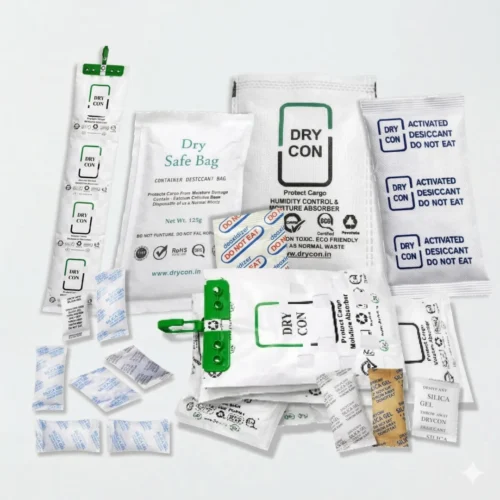
Different container desiccant formats may also suit different applications. For example, desiccant strips may be positioned within the container to provide moisture absorption across the cargo environment. Bags and other high-capacity formats may be selected for specific shipping conditions. The supplier should provide guidance on application and capacity rather than recommending a fixed quantity for every shipment.
DryCon provides container desiccant strips, container desiccant bags, and other desiccant solutions for moisture-sensitive applications. Its product range also includes oxygen absorbers for sealed packaging systems.
Quick Tip: Ask for technical data that explains absorption capacity, recommended application, storage conditions, handling requirements, and batch identification. This helps your QA and procurement teams compare suppliers on more than price.
Oxygen Absorbers for Food Preservation
Moisture is only one factor that can affect food quality during storage and distribution. Oxygen can also contribute to oxidation and quality deterioration in suitable food products. Oxygen absorber packets are designed to reduce residual oxygen inside properly sealed packages. They may be considered for suitable dry and semi-dry foods where oxygen can affect:
- Oxidation
- Rancidity
- Color stability
- Product quality
- Certain forms of microbial activity
The exact application depends on the food and packaging system. An oxygen absorber works differently from a moisture absorber. The selection of an oxygen absorber should consider:
- Package volume
- Headspace
- Initial oxygen level
- Packaging oxygen transmission
- Expected shelf life
- Product characteristics
- Seal integrity
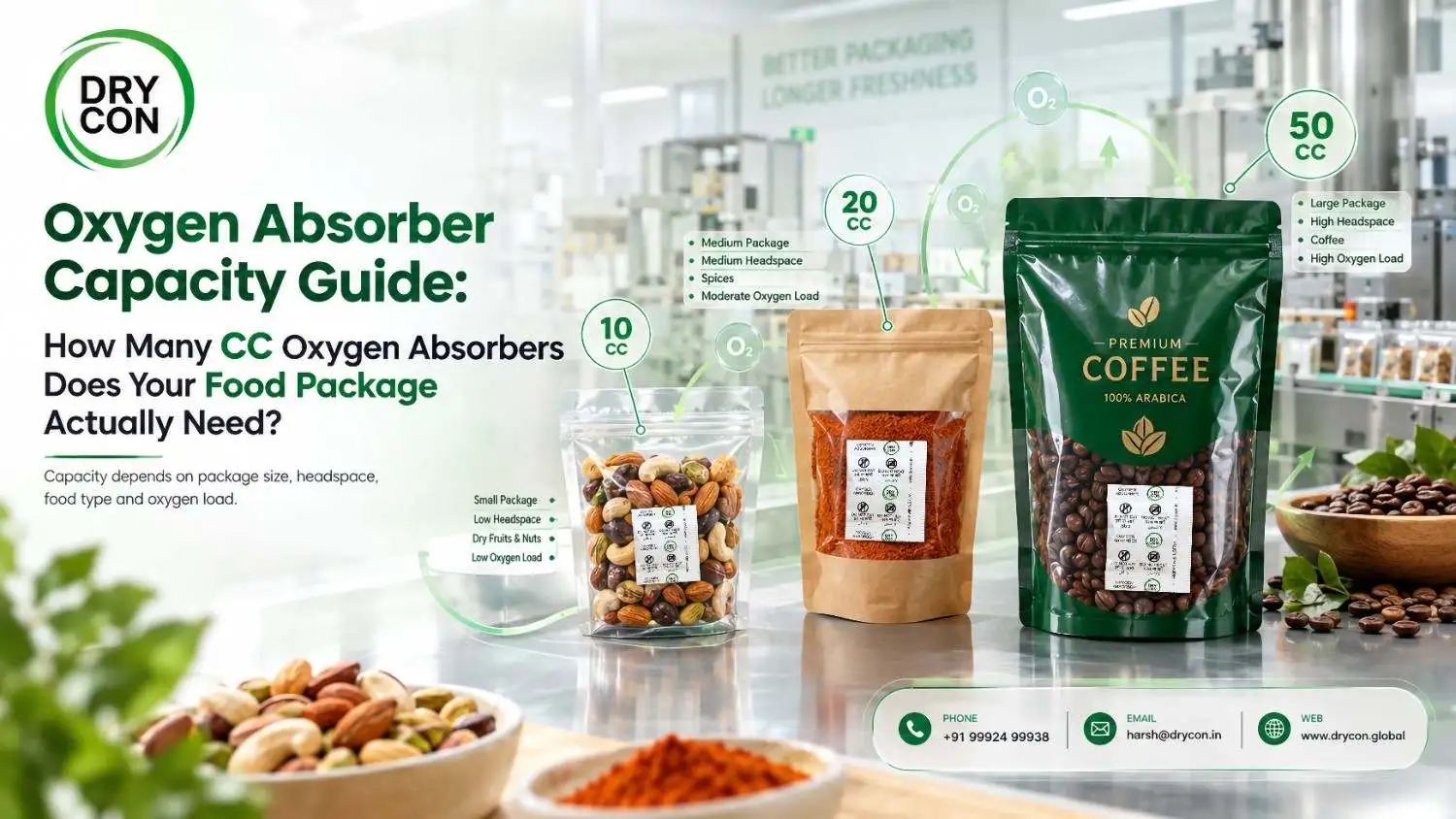
The absorber capacity should be selected according to the oxygen load that needs to be controlled. This is particularly important for food manufacturers producing multiple package sizes. A single absorber capacity may not be suitable for every pack format.
NOTE: Fresh fruits require special consideration.
Fresh produce continues to respire after harvest. Its packaging environment may need controlled gas exchange rather than oxygen removal. Therefore, oxygen absorbers designed for dry packaged foods should not automatically be used for fresh fruits.
For dried fruits and dehydrated fruit products, the packaging requirements may be different. The product’s moisture level, water activity, oxygen sensitivity, and packaging barrier should guide the decision. This is where product-specific testing becomes important.
Preventing Food Spoilage During Transit
Food spoilage prevention starts before shipping. A moisture-control product cannot replace good food processing and packaging practices. Before a shipment is released, QA teams should confirm that:
- The product meets its moisture specification
- Water activity is within the defined range
- Packaging seals are intact
- Packaging materials meet specifications
- The product is stored correctly
- Moisture-control products are correctly applied
- The container is suitable for loading
Laboratory testing can help validate these controls. Depending on the product, testing may include:
- Moisture content
- Water activity
- Microbiological parameters
- Package seal integrity
- Barrier performance
- Sensory quality
- Oxygen concentration where relevant
For new export products, controlled shelf-life studies can help establish whether the packaging system provides the intended protection. The same applies when changing suppliers. A new desiccant or oxygen absorber should not be treated as automatically equivalent to the previous product. Its performance should be assessed against the actual application.
Protecting Food Products From Moisture During International Shipping
Humidity can change significantly during a shipment. A container may start its journey in a warm environment and later move through cooler conditions. The cargo may also spend time at ports or warehouses before reaching the final customer. This makes humidity control for food products an important part of export planning. Before selecting a moisture-control product, review:
- Route and climate – Consider the origin, destination, season, and expected transit route.
- Shipping duration – A short domestic shipment may have a different risk profile from a long ocean voyage.
- Product sensitivity – A moisture-sensitive powder may require more protection than a product with a higher tolerance for humidity.
- Packaging barrier – A high-barrier package may reduce moisture movement into the product.
- Container conditions – The container should be dry, clean, and suitable for the cargo before loading.
- Cargo arrangement – Cargo should be loaded in a way that supports the intended protection system and avoids unnecessary exposure to container surfaces.
Capacity planning is also important. Exporters with regular shipments should estimate monthly and seasonal demand for desiccants and oxygen absorbers. This reduces the risk of production delays caused by unexpected shortages.
How to Protect Food From Condensation During Shipping?
Condensation is a major concern in long-distance transport. It can occur when warm, humid air inside a container cools below its dew point. Water may then condense on cooler surfaces. This is often called container rain when droplets form on the container ceiling and fall onto the cargo. The damage can include:
- Wet cartons
- Weakened corrugated packaging
- Damaged labels
- Moisture-sensitive product exposure
- Increased risk of mold where conditions permit
Good condensation prevention requires more than one action. Exporters should:
- Load dry products
- Use dry pallets
- Check containers before loading
- Avoid loading wet packaging
- Maintain suitable product packaging
- Use container desiccants where appropriate
- Follow suitable cargo-loading practices
Container desiccants can help reduce the moisture available for condensation. They cannot, however, remove large amounts of water from wet cargo or repair poor packaging. This is why moisture-control products should be viewed as one part of a complete export packaging protection strategy.
Which Food Products Need the Most Moisture Protection?
Moisture sensitivity varies by product. Products that may require careful moisture management include:
- Dried fruits
- Dehydrated vegetables
- Spices
- Seasoning powders
- Dry snacks
- Biscuits and bakery products
- Cereals
- Grains
- Powdered ingredients
- Confectionery
- Nutraceutical products
The actual risk depends on the product’s formulation and packaging. For example, two products in the same category may have different water activity levels and different packaging barriers. This is why procurement teams should avoid choosing a moisture absorber for shipping containers based only on the product category. The shipping conditions matter just as much.
Why Manufacturer Selection Matters?
The supplier you choose becomes part of your quality-control process. A low-cost product may appear attractive during procurement. But if its performance varies between batches, the cost of product damage can be much higher. A reliable manufacturer should be able to discuss:
- Product specifications
- Absorption capacity
- Recommended applications
- Storage conditions
- Handling instructions
- Batch traceability
- Quality checks
- Supply capacity
- Technical support
For food applications, buyers should also review documentation relevant to their market and intended use. Exporters may need to meet destination-country requirements and customer specifications.
Food packaging procurement teams should therefore evaluate suppliers on technical suitability, consistency, documentation, and supply reliability.
DryCon as a manufacturer of desiccants and absorbent solutions for applications across packaging, storage, processing, transportation, and export. Its product categories include silica gel, container desiccants, activated clay desiccants, and oxygen absorbers.
The right supplier is not necessarily the one with the lowest price. It is the one that can help you choose the right product for the actual risk.
Reliable Manufacturer vs Generic Supplier: What to Compare?
Feature |
DryCon as Reliable Manufacturer |
Generic Supplier |
| Product Specification | Clearly defined | Vary by batch or source |
| Application Guidance | Technical support available | Often limited |
| Capacity Selection | Based on application data | Use standard quantities |
| Batch Traceability | Clear batch identification | Often unclear |
| Quality Control | Defined product checks | Depends on third-party source |
| Documentation | Available for evaluation | Mostly incomplete |
| Supply Planning | Better suited for repeated orders | Availability fluctuates |
| Customization | Application-specific formats | Limited |
| Storage Guidance | Clearly provided | Mostly inconsistent |
| Technical Accountability | Manufacturer-level responsibility | Multiple parties involved |
The purpose of this comparison is not to suggest that every generic supplier is unsuitable. The point is to help procurement teams ask better questions. When food products are shipped over long distances, the cost of a packaging failure can exceed the cost difference between two moisture-control products.
Expert Buying Checklist for Food Manufacturers and Exporters
Before selecting a moisture-control supplier, ask the following questions.
About the product
- What type of moisture-control product is suitable for my application?
- Is it intended for use inside food packaging or shipping containers?
- What is its absorption capacity?
- What factors affect its performance?
About quality
- Is every batch traceable?
- Are product specifications documented?
- How is quality checked?
- Can the supplier provide relevant technical documentation?
About storage
- How should unused products be stored?
- What happens after the outer packaging is opened?
- What storage conditions are recommended?
About shipping
- How should the product be placed?
- How much is required for the intended application?
- Does container size affect the recommendation?
- Does voyage duration affect the required capacity?
About supply
- Can the supplier support your monthly requirement?
- Can supply be planned for seasonal demand?
- Are multiple product formats available?
- What is the expected lead time?
About export compliance
- Does the product meet the requirements relevant to the destination market?
- Is appropriate documentation available?
- Can the supplier support your QA review?
This checklist can reduce uncertainty before a purchase order is placed.
How to Choose the Right Moisture Control Solution?
A simple decision process can help.
- If the problem is moisture inside a sealed food package:
Evaluate the packaging barrier and consider a suitable desiccant.
- If the problem is oxygen inside a sealed package:
Evaluate whether an oxygen absorber is appropriate.
- If the problem is humidity inside a shipping container:
Consider container-level moisture control.
- If the product itself contains too much moisture:
Review the drying or processing stage.
- If moisture enters through the package:
Review packaging material and seal integrity.
- If condensation occurs during transport:
Review container conditions, cargo moisture, temperature changes, and container desiccant use.
The best solution is often a combination of controls. The goal is not to use the maximum amount of protective material. The goal is to use the right protection for the actual risk.