
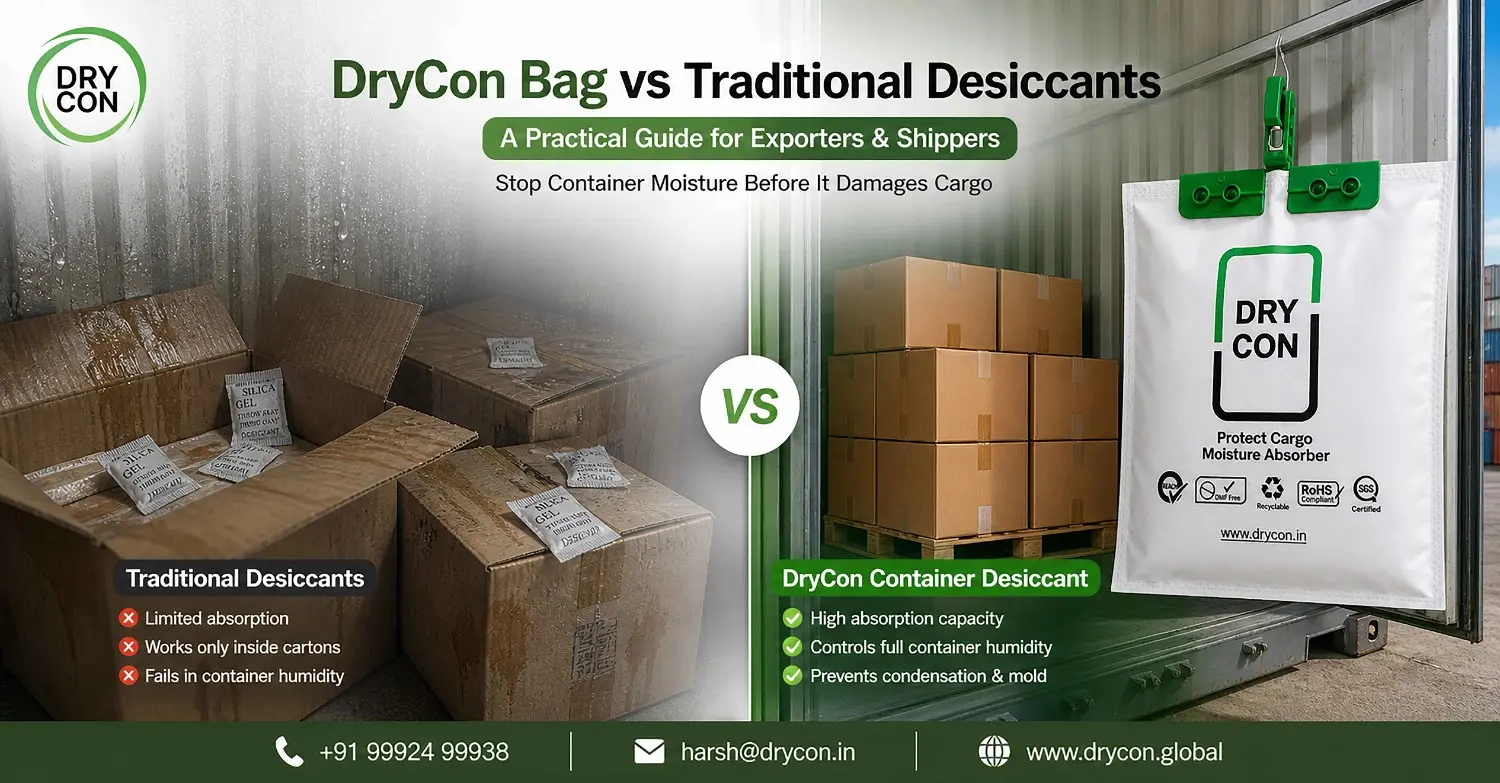
DryCon Bag vs Traditional Desiccants: A Practical Guide for Exporters and Shippers

calendar
May 10, 2026
Written by
Harsh Joshi

Harsh Joshi

Drycon Bag vs Traditional Desiccants

Shipping cargo across oceans means crossing heat, cold, humidity, and time zones. Inside the container, these changes create moisture. That moisture quietly damages goods. Many exporters invest in strong cartons, pallets, and careful loading. Yet they miss the real risk: container humidity. This is where the choice of DryCon bag vs traditional desiccants becomes important for anyone who wants reliable cargo protection during export.

Why Moisture Is a Serious Problem in Shipping Containers

A container is sealed but not airtight.

During transit:

  • Day heat and night cooling create condensation
  • Water forms on container walls and ceiling
  • Droplets fall on cartons and goods
  • Mold, rust, and weak packaging follow

Understanding Traditional Desiccants

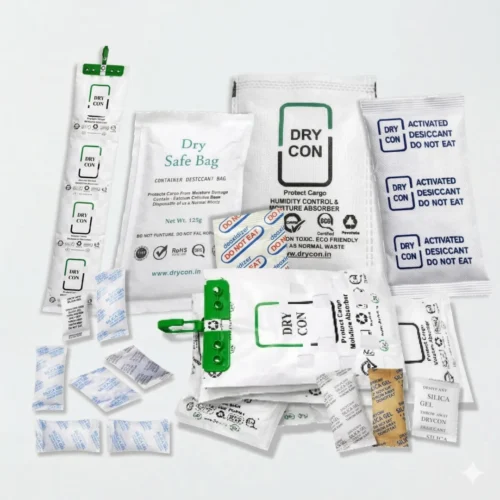
Traditional desiccants commonly used in packaging that include:

Among these, silica gel is the most widely recognized. It is commonly placed inside cartons or product packaging to absorb minor moisture present in a closed pack. However, traditional desiccants were never designed for container-level humidity control.

They are effective for:

  • Small packaging environments
  • Short storage durations
  • Limited moisture exposure

They are not designed for:

  • 30 to 60 days of ocean transit
  • High humidity coastal routes
  • Large air volume inside containers

This forms the base of the traditional desiccant vs container desiccant bags discussion.

Also Read : 7 Costly Shipping Problems Solved by Container Desiccant Bags

What Is a Container Desiccant Bag?

A container desiccant bag, such as the DryCon Container Desiccant Bag, is engineered specifically for:

  • Large air volume inside shipping containers
  • Long-distance sea and land transit
  • High condensation risk zones
  • Prevention of container rain

Unlike small pouches, these are high absorption desiccants for containers that are hung strategically inside the container to control overall humidity.

Moisture Absorption Capacity of Container Desiccants vs Traditional Options

One of the most critical aspects in this desiccant performance comparison for shipping is absorption capacity.

Parameter

Traditional Desiccants

Drycon Container Desiccant Bag

Designed for Small packaging Full container environment
Moisture absorption capacity Low to moderate Extremely high
Duration effectiveness Short term Ideal for long-distance shipping
Placement Inside cartons Hung across container walls
Risk of leakage Possible Anti-leak gel technology
Container rain prevention Ineffective Highly effective

Traditional desiccants saturate quickly because they are not built to handle the moisture load inside a 20ft or 40ft container. This is where the DryCon container desiccant benefits for shipping become evident.

Why Traditional Desiccants Fail in Containers?

Exporters often place hundreds of silica gel pouches inside cartons hoping to control moisture. However:

  • They absorb only local moisture inside cartons
  • They do not control ambient container humidity
  • They get saturated within days
  • They cannot prevent condensation on container walls

This makes them a poor choice when evaluating which desiccant works best for long-distance shipping.

How DryCon Bag Controls Container Humidity?

The DryCon bag vs traditional desiccants comparison becomes clear when you understand the working principle.

DryCon bags:

  • Absorb moisture from the entire container air
  • Convert moisture into gel form and lock it
  • Prevent dripping and leakage
  • Maintain safe humidity levels throughout transit
  • Prevent container rain, mold, and corrosion

This is why they are considered the best desiccant for cargo protection during export.

Also Read : 11 Proven Benefits of Desiccants in Pharmaceuticals for Drug Stability

Industrial Desiccant Comparison for Logistics

For logistics planners and exporters, this is not a theoretical decision. It is an industrial desiccant comparison for logistics efficiency.

Industries that benefit most from container desiccant bags:

These industries require bulk cargo moisture protection solutions rather than carton-level moisture control.

Real Problem: Condensed Moisture

  1. Condensed moisture is the primary reason exporters shift from silica gel to container desiccants.
  2. When temperature drops at night, condensation forms on container ceilings and walls. These droplets fall directly onto cargo.
  3. Traditional desiccants cannot stop this. DryCon bags are designed specifically to prevent this phenomenon.

Practical Recommendation for Exporters

The only reliable answer in the traditional desiccant vs container desiccant bags debate is container desiccant bags. It works best for shipments that last 30 – 60 days across humid routes.

If your cargo value is high and sensitive to moisture:

  • Do not rely only on silica gel
  • Use container desiccant bags strategically
  • Calculate required quantity based on container size and cargo type

This is the most practical takeaway from the DryCon bag vs traditional desiccants discussion.

Ready to Stop Moisture Condensation Before it Damages Your Cargo?

Keep your cargo dry, protected, and export-ready with advanced moisture control solutions.

Conclusion

The comparison between container desiccant bag and silica gel clearly shows that traditional desiccants serve packaging needs, while container desiccant bags serve logistics needs.

For exporters serious about cargo protection during export, the choice is clear.

The DryCon container desiccant benefits for shipping include:

  • Prevention of container rain
  • High moisture absorption capacity
  • Long duration effectiveness
  • Protection against mold and corrosion
  • Reliable performance across long-distance shipping routes

When evaluating the best desiccant for cargo protection during export, container desiccant bags stand far ahead in the desiccant performance comparison for shipping.

Choosing DryCon as the right bulk cargo moisture protection solution is not an expense. It is an investment in cargo safety, brand reputation, and customer trust.

Frequently Asked Questions

1. What is a DryCon bag and how is it different from traditional desiccants?

The DryCon Container Desiccant Bag functions as a special container desiccant which maintains humidity control throughout all air space within a shipping container. The main difference between the DryCon bag and traditional desiccants lies in their respective operational boundaries according to the DryCon bag vs traditional desiccants study. The traditional desiccant Silica gel functions as a moisture-absorbing material which protects small sealed packaging areas including cartons. The DryCon bag functions as a container moisture control system which delivers export shipping solutions for bulk cargo moisture management.

2. Which desiccant offers higher moisture absorption capacity?

The moisture absorption capacity of container desiccants shows that container desiccant bags provide better results than traditional desiccant options. DryCon bags function as container desiccants with high absorption capabilities because they can absorb multiple times the moisture of standard silica gel pouches. The shipping desiccant performance assessment needs this particular element because it plays an essential role during extended shipping periods.

3. Are container desiccant bags better for long shipping durations?

Yes. DryCon bags operate as the most effective desiccant for cargo protection during international shipping because they absorb moisture throughout their entire shipping period which extends beyond traditional desiccants that reach saturation too fast.

4. How do traditional desiccants like silica gel compare in performance?

In a comparison between container desiccant bag and silica gel, silica gel performs well inside product packaging but poorly in managing ambient container humidity. Silica gel cannot prevent condensation on container walls, which leads to container rain. This limitation is central to the traditional desiccant vs container desiccant bags debate.

5. Which option is more cost-effective for bulk shipping?

At first glance, traditional desiccants may appear cheaper. However, for exporters seeking bulk cargo moisture protection solutions, the real cost includes potential cargo damage, mold formation, corrosion, and claim losses. DryCon bags provide better value in the long term by offering reliable cargo protection during export and reducing risk.

6. Can DryCon bags prevent container rain more effectively?

Yes. Preventing container rain is one of the primary DryCon container desiccant benefits for shipping. By controlling overall container humidity and locking absorbed moisture into gel form, DryCon bags stop condensation from forming and dripping onto cargo, something traditional desiccants cannot achieve.

7. Are traditional desiccants suitable for container shipping?

Traditional desiccants are suitable for carton-level moisture control, not for full container environments. In the industrial desiccant comparison for logistics, they fall short when used as the only moisture protection method in containers. They can be used as a supplementary solution but not as the primary defense.

8. What industries benefit most from container desiccant bags?

Industries that require strong cargo protection during export and depend on high absorption desiccants for containers include:

  • Food and agro products
  • Pharmaceuticals
  • Textiles and garments
  • Engineering goods and metals
  • Electronics
  • Furniture and wooden products

These industries rely heavily on effective desiccant performance comparison for shipping before choosing a solution.

9. How do you choose between DryCon and silica gel?

The decision in the DryCon bag vs traditional desiccants debate depends on the level of protection required.

  • For packaging moisture: silica gel is sufficient
  • For container humidity control: DryCon bag is essential

Exporters often use both, but for true bulk cargo moisture protection solutions, container desiccant bags are necessary.

10. Do container desiccants require special installation?

No complex installation is required. Proper placement ensures maximum effectiveness and delivers the full DryCon container desiccant benefits for shipping across the entire container space.

Read more insights on
  • WhatsApp
  • X
  • LinkedIn

Want the Best Desiccant for Cargo Protection During Export?

Discover why DryCon Bags outperform traditional desiccants in preventing container moisture damage during export shipping and long-distance cargo transit.

EMAIL US

harsh@drycon.in

Trusted By

AWL.NS_BIG 1
Godrej
Navneet
Reliance Industries
Chiripal
Vishakha
Larsen & Toubro
Aashirvaad
Cinos
Haldirams
AptarGroup
Daikin
Sintex
Lubi Pumps
Juki
social-call social-mail social-whatsapp