



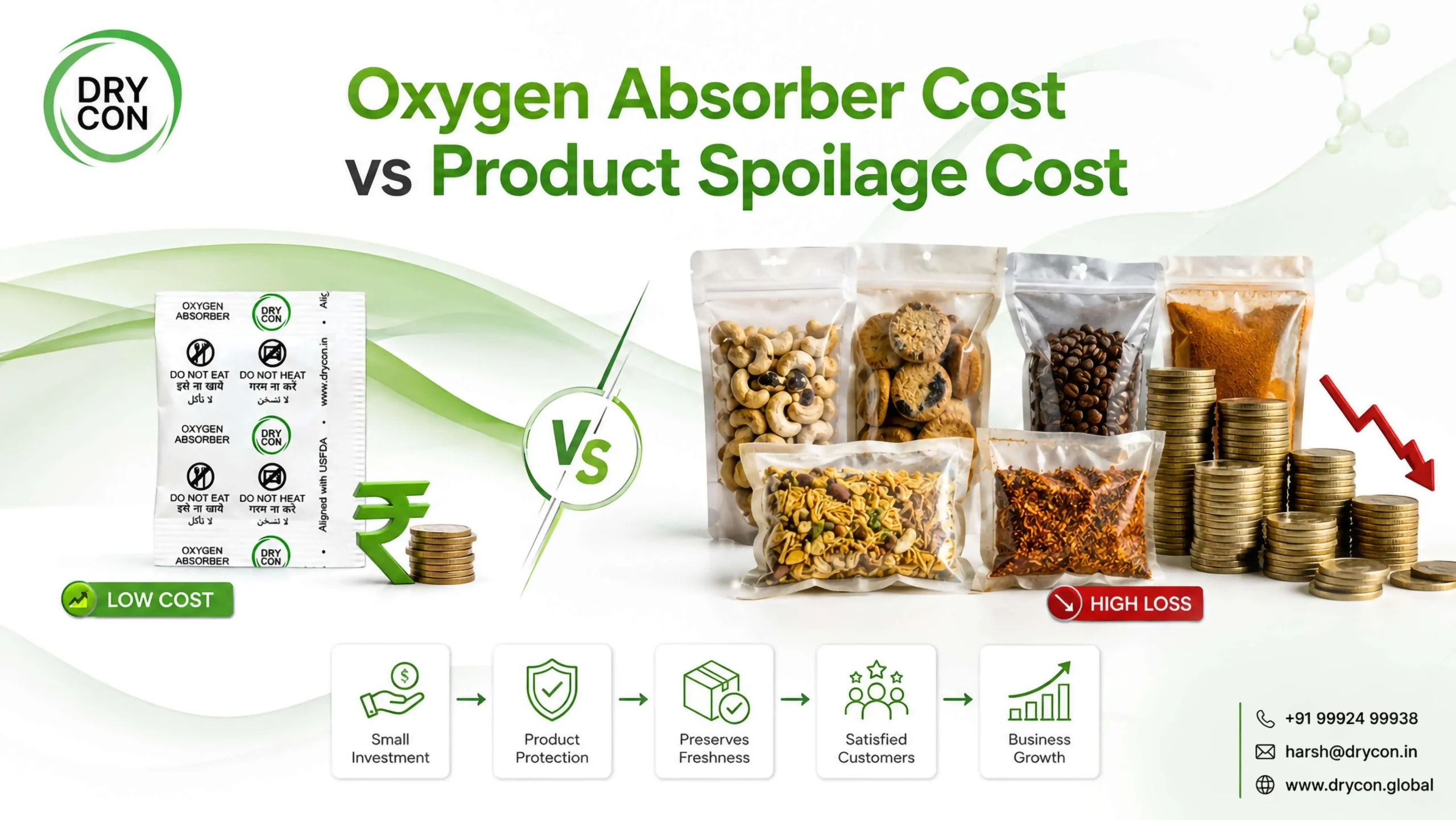
For food manufacturers, the whole oxygen absorber cost vs product spoilage cost thing is usually not really about the price of a single sachet. It is more like, the real question becomes: can a tiny packaging add-on quietly stop a far bigger loss from oxidation , rancidity , nasty quality complaints, rejected export lots, or even the end result of unsold stock.
And honestly, this gets even more critical for dry fruits , nuts , seeds, bakery goods, snacks, spices, and basically the rest of those oxygen-sensitive foods. Oxygen can be hanging around inside a sealed pack even after filling. It can also show up later if the pack has weak barrier properties or if the seals have small defects , or just aren’t tight enough.
An oxygen absorber is made to pull oxygen out of a properly sealed package, you know, so the product doesn’t get rattled by air. The goal feels simple enough: lower the oxygen that could be used in chemical changes which might end up damaging the goods.
For procurement teams, the right call isn’t just a unit price thing. It’s more like, you need to look at pack size, the headspace amount, the packaging barrier performance, absorber capacity, storage conditions, the likely shelf life, and then even the financial fallout from rejected units or spoiled items.
Oxygen Absorber Cost Vs Food Spoilage Cost
The easiest mistake is to compare the price of an oxygen absorber with the price of the food alone. A better calculation includes the full cost of a failed pack. The important point is that food-grade oxygen absorbers do not automatically prevent every form of spoilage. They address oxygen-related deterioration. Moisture, temperature, microbial contamination, poor sealing, light, and unsuitable storage can still damage food.
A Simple Cost Comparison
Cost Factor |
Without Adequate Oxygen Control |
With Correctly Selected Oxygen Absorbers |
|---|---|---|
| Sachet Cost | None | Additional packaging cost |
| Oxidation Risk | Higher when oxygen remains | Lower when the system is suitable |
| Product Shelf Life | May be limited by oxidation | Can support longer shelf life |
| Returns | Potentially higher | Potentially lower |
| Export Rejection Risk | Depends on product and packaging | Can be reduced through better oxygen control |
| Product Waste | More stock may be lost | Less waste may occur when protection works |
| Customer Complaints | Quality changes can trigger complaints | Better quality stability can reduce complaints |
| Packaging Planning | Lower initial cost | Higher initial cost; more controlled protection |
What Should Manufacturers Calculate?
A practical food spoilage prevention cost calculation can include:
- Product value lost
- Packaging material already used
- Labor and processing cost
- Warehousing cost
- Reverse logistics
- Disposal cost
- Replacement product cost
- Export or distributor penalties
- Customer service costs
- Lost sales from quality complaints
This gives procurement teams a much better view of the oxygen absorber cost vs product spoilage cost decision.
Important: Do not approve an absorber only because it is the cheapest sachet. First determine how much oxygen the pack actually needs to control.
Are Oxygen Absorbers Worth The Cost?
For the right products, food grade oxygen absorbers can be a sensible piece of food preservation packaging, more or less. They work especially well in places where oxygen helps drive rancidity, shifts the color, reduces flavor, dulls aroma, or triggers some other sort of steady quality breakdown.
Dry fruits make a really clear example. Almonds, cashews, walnuts, seeds and similar items have fats that can oxidize while they sit in storage. By lowering oxygen exposure in practice, you can therefore support stronger quality defense. However, the absorber is only one part of the packaging system.
The pack must also provide suitable oxygen barrier properties. Seals must be reliable. The product must meet the moisture and microbiological requirements for the intended shelf life. This is why the cheapest oxygen absorber cost is not always the lowest total packaging cost. A failed packaging system can make an inexpensive absorber expensive.
Also Read : A Practical Guide to Moisture Control for Food Products to Prevent Damage During Shipping
How Oxygen Absorbers Reduce Product Spoilage?
Most food-grade oxygen absorbers use an oxygen-reactive system. Iron-based absorbers, for example, consume oxygen through an oxidation reaction. The absorber does not remove oxygen from the entire production area. It works inside the sealed package. This makes package design critical. The oxygen load can come from:
- Oxygen already present in the headspace.
- Oxygen trapped between food pieces.
- Oxygen that enters through the packaging material.
- Oxygen introduced during filling and sealing.
The absorber capacity should therefore be selected based on the complete package system rather than simply the food weight.
At DryCon, businesses get capacity selection that considers package volume, headspace oxygen, product density, and expected shelf life. That is the type of technical assessment procurement teams should request from an Oxygen Absorber Manufacturer.

Cost Savings from Oxygen Absorbers
The financial benefit comes from avoided losses. An absorber may add only a small amount to each pack. But if oxidation causes a meaningful portion of the stock to become unacceptable, the loss can quickly exceed the packaging addition. The exact savings cannot be stated without actual production and failure data.
Manufacturers should therefore track:
- Number of rejected packs
- Return rate
- Spoilage rate
- Complaint rate
- Average product value per pack
- Export rejection incidents
- Shelf-life failures
- Cost per replacement unit
This creates a real business case instead of relying on a generic claim about savings.
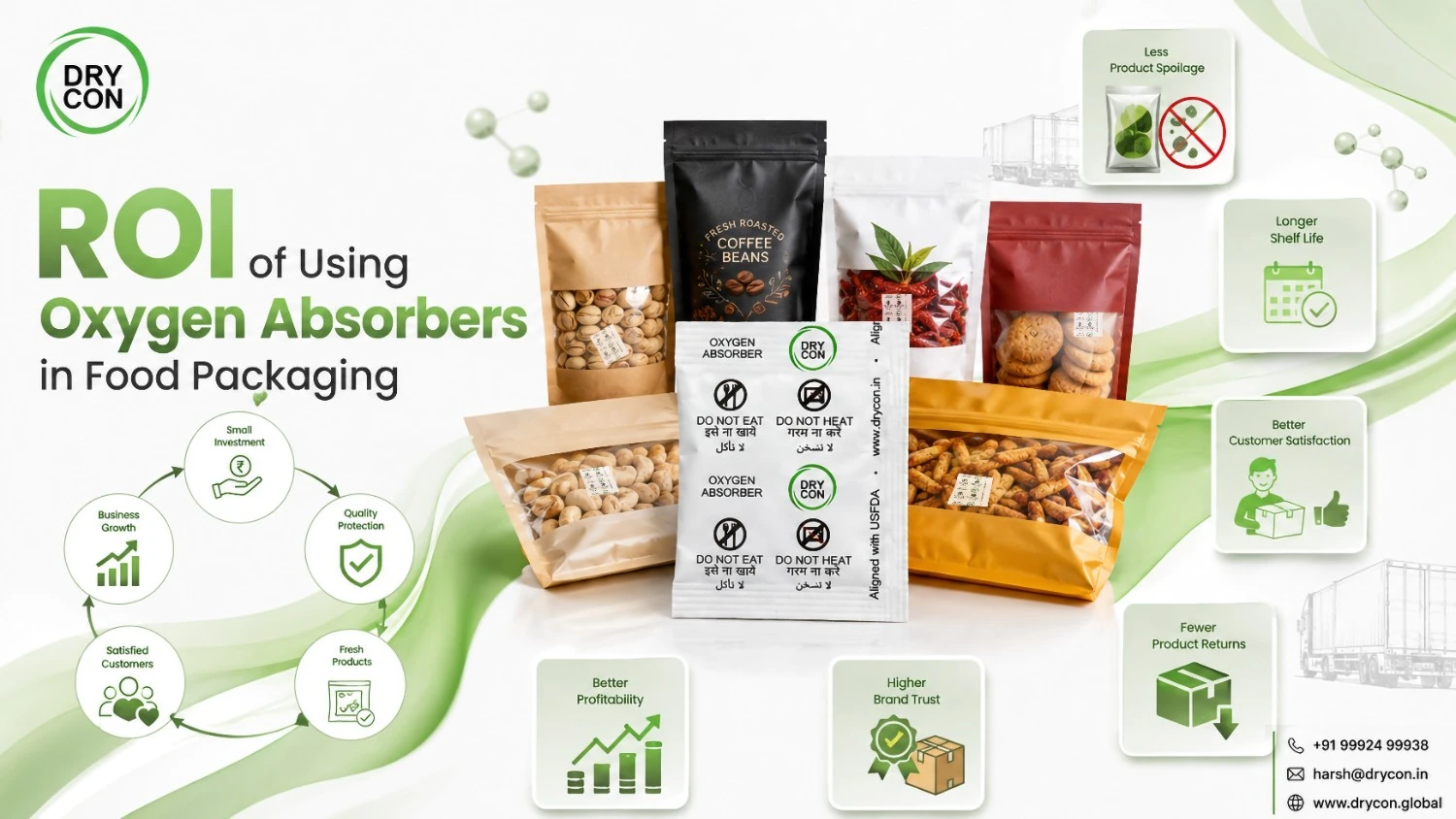
Food Packaging ROI with Oxygen Absorbers
The food packaging cost should be evaluated against the value protected. A simple ROI model can use:
Avoided spoilage value − additional packaging cost = potential packaging benefit
For example:
- Annual production: 500,000 packs
- Absorber cost per pack: ₹0.50
- Annual absorber spend: ₹2.5 lakh
- Avoided product loss: ₹8 lakh
The potential gross benefit would be ₹5.5 lakh before considering other operational costs. These numbers are only an example. A manufacturer should replace them with its own production and spoilage figures.
What improves packaging ROI?
The strongest results usually come from matching several factors:
- Correct absorber capacity
- High-barrier packaging
- Reliable heat seals
- Correct insertion timing
- Controlled storage
- Suitable product moisture level
- Proper batch handling
- Regular packaging validation
This is why an absorber should be treated as part of a food packaging solution, not as an isolated sachet.
Also Read : Best Oxygen Absorbers for Dry Fruit Packaging: A Buyer’s Guide
Reducing Food Waste Using Oxygen Absorbers
Food waste reduction has a direct financial value for manufacturers. If a finished product becomes unacceptable before reaching the customer, all the resources used to produce it are effectively lost. This includes ingredients, energy, labor, packaging, transport, and warehouse space.
Oxygen control can help reduce one source of quality deterioration where oxidation is a relevant failure mechanism. For exporters, the issue can become more important because products may spend longer periods in storage and transit.
However, food-grade oxygen absorber manufacturers cannot compensate for poor packaging or unsuitable storage.
For food waste reduction, check:
- Is the product oxygen-sensitive?
- Is the package sufficiently airtight?
- Is the oxygen barrier suitable?
- What is the package headspace?
- What absorber capacity is required?
- How quickly must the pack be sealed?
- What temperatures will the product face?
- How long will the product remain in storage?
- Does the absorber remain stable during handling?
These questions are more useful than simply asking for the lowest oxygen absorber cost.
Preventing Oxidation in Packaged Foods
Oxidation has a way of affecting fats, pigments, flavors, aromas, and various other food components. It is kind of noticeable that dry fruits and nuts are especially relevant, because lipid oxidation can end up giving rancid tastes and even odors. Also, baked goods, snack items, spices, dehydrated foods, and some other products, might gain from oxygen control depending on their formulation, and the packaging system that they use.
Oxygen absorbers can be used alongside vacuum or nitrogen-flushing systems. DryCon specifically lists use with vacuum and nitrogen-flushed packaging among its applications. The purpose is different from that of Food Grade Desiccants. A desiccant controls moisture. An oxygen absorber controls oxygen.
If the primary problem is humidity or clumping, a food-grade desiccant may be more appropriate. If oxidation is the main concern, an oxygen absorber may be relevant. Some products may require both.
Best Oxygen Absorbers for Food Storage
The correct selection depends on the package and product. Here is the procurement checklist to confirm before ordering oxygen absorber packets:
- Oxygen capacity required
- Package headspace
- Product weight and density
- Packaging material
- Seal integrity
- Product fat content
- Expected shelf life
- Storage temperature
- Transit conditions
- Export destination
- Sachet size and format
- Required batch documentation
- Minimum order quantity
- Storage life of unused sachets
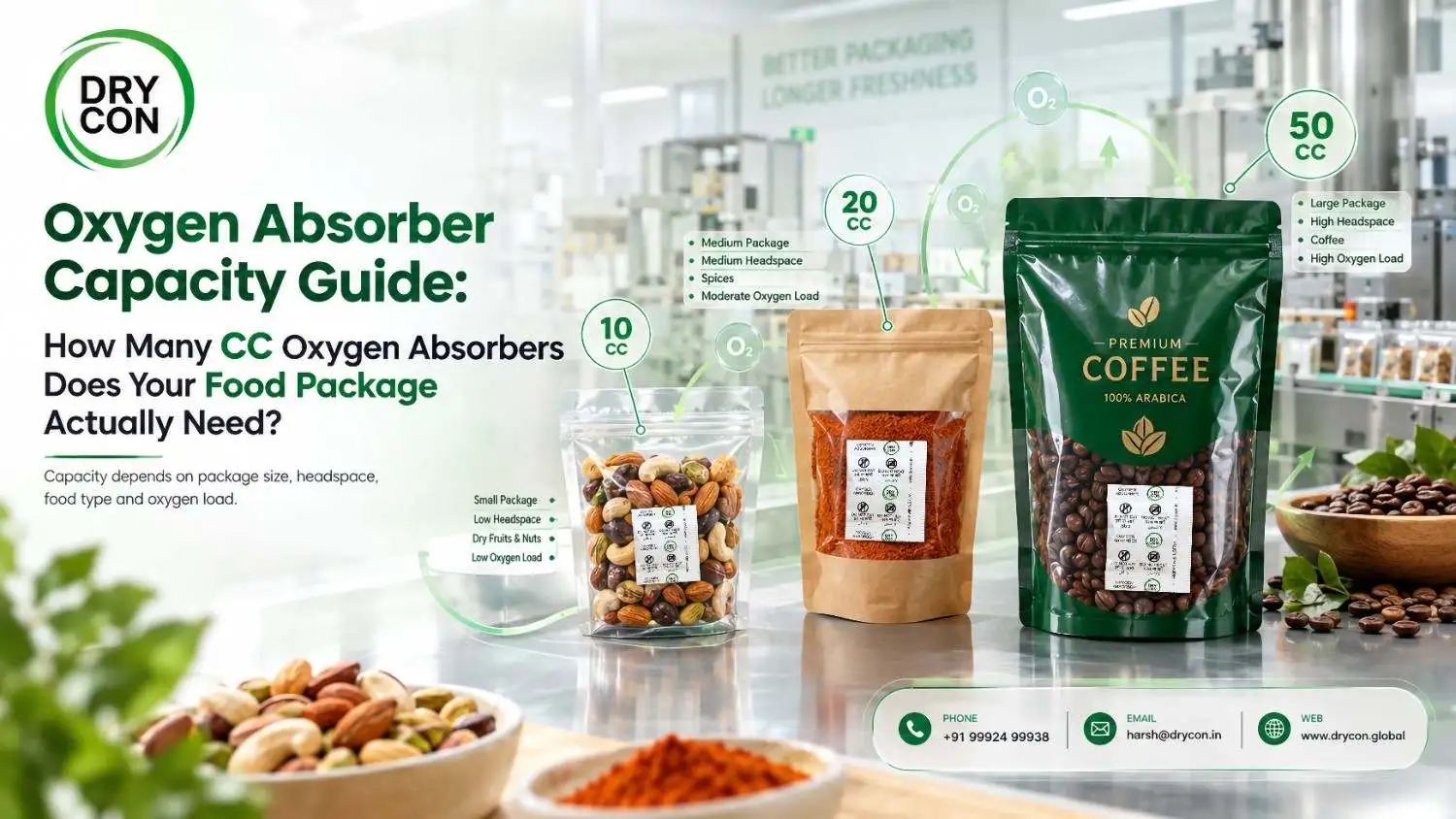
DryCon provides 20cc, 30cc and 50cc food-grade oxygen absorber formats, with applications including bakery, snacks, dry fruits, spices and other packaged foods.
The production batches at DryCon undergo checks including oxygen absorption capacity, iron content, sealing strength, sachet weight, and packaging integrity. For a procurement manager, these details are more useful than a generic high-performance claim.
Also Read : Foods That Need Oxygen Absorbers and Which Foods Should Never Use Them
Oxygen Absorber Cost for Food Manufacturers
The purchase price depends on capacity, quantity, material, printing, packaging configuration, and other specifications. For bulk purchasing, ask suppliers for a quotation based on:
- Required capacity
- Annual consumption
- Monthly call-off volume
- Sachet dimensions
- Printed or plain format
- Primary packaging requirements
- Outer master-pack configuration
- Delivery schedule
- Export requirements
Important: Do not compare suppliers using price per piece alone. A ₹0.40 sachet with unsuitable capacity can be more expensive than a ₹0.60 sachet that performs correctly.
Supplier Comparison Checklist: DryCon vs Generic Supplier
Feature |
DryCon as Your Reliable Manufacturer & Supplier |
Random Generic Supplier |
|---|---|---|
| Capacity Selection | Based on package requirements | Often price-led |
| Batch Traceability | Clearly documented | May vary |
| Absorption Testing | Batch validation available | May not be consistent |
| Sachet Integrity | Defined quality checks | Supplier dependent |
| Technical Support | Packaging-focused guidance | Usually limited |
| Bulk Planning | Production scheduling possible | Stock availability may vary |
| Customization | Capacity and format options | May be restricted |
| Export Support | Packaging & storage guidance | Depends on supplier |
Packaging Solutions to Reduce Spoilage
The strongest food packaging solutions combine material selection, sealing, oxygen management, moisture control, and storage discipline. For oxygen-sensitive products, the packaging engineer should assess the entire system. A practical validation process is:
Step 1: Identify the failure mode
Is the product becoming rancid, stale, moldy, discolored, damp, or otherwise unacceptable?
Step 2: Identify the cause
Do not assume oxygen is the cause. Review moisture, oxygen, temperature, light, microbial risks, and packaging integrity.
Step 3: Measure the package
Record pack volume, headspace, product weight, packaging type, and seal configuration.
Step 4: Select the absorber
Choose the capacity based on the expected oxygen load and packaging conditions.
Step 5: Run a controlled trial
Compare packs with and without oxygen control under defined storage conditions.
Step 6: Test the product
Use suitable laboratory methods to monitor the quality attributes that matter for the product.
Step 7: Review the data
Check whether the packaging change actually improves stability.
Step 8: Scale carefully
Only after validation should the selected format move into full production.
Why Laboratory Testing Matters?
Shelf-life extension should never be based only on a supplier’s brochure. Manufacturers should really validate the finished product while it is in its actual packaging, like not just a sample pulled out. Testing may include oxygen levels, sensory quality , peroxide or oxidation indicators where it makes sense, moisture, microbiological parameters , seal integrity , and other measurements that fit the product.
The whole test plan should be decided by the QA and technical teams, based on the food itself and the intended shelf life. Batch traceability also matters. A good packaging program should allow the manufacturer to identify:
- Absorber batch number
- Production date
- Capacity
- Quantity received
- Packaging material
- Finished-product batch
- Supplier documentation
- Storage conditions
This becomes valuable when investigating a complaint or unexpected shelf-life failure.
Export planning requires more attention. Export products can face long transit times, changing temperatures, warehouse delays, and different handling conditions. Procurement teams should therefore plan absorber supply around actual production schedules.
Unused oxygen scavenger packets should remain properly sealed until use. DryCon advises keeping unused absorber bags sealed and inserting the sachet immediately before final sealing.
How to Choose Right Oxygen Absorber Manufacturer for Your Food Brand?
For food manufacturers, the best supplier is not necessarily the one offering the lowest quotation. Look for a supplier that can explain why a particular capacity and sachet format suits your product.
DryCon positions itself as a direct oxygen absorber manufacturer and it operates controlled production with in-house batch validation. Its food-packaging range also includes silica gel and other moisture-control products.
For dry fruits and other oxygen-sensitive foods, this distinction is useful because the technical discussion should cover the complete packaging environment. Ask potential suppliers for:
- Product specification sheet
- Absorption capacity information
- Batch testing details
- Sachet material information
- Recommended application range
- Storage instructions
- Sample quantities for trials
- Minimum order quantity
- Lead time
- Batch traceability process
- Export documentation, where required
Do not select a supplier until your QA and packaging teams are comfortable with the technical evidence.
Also Read : Oxygen Absorber Manufacturer Evaluation Guide for Food Packaging Buyers