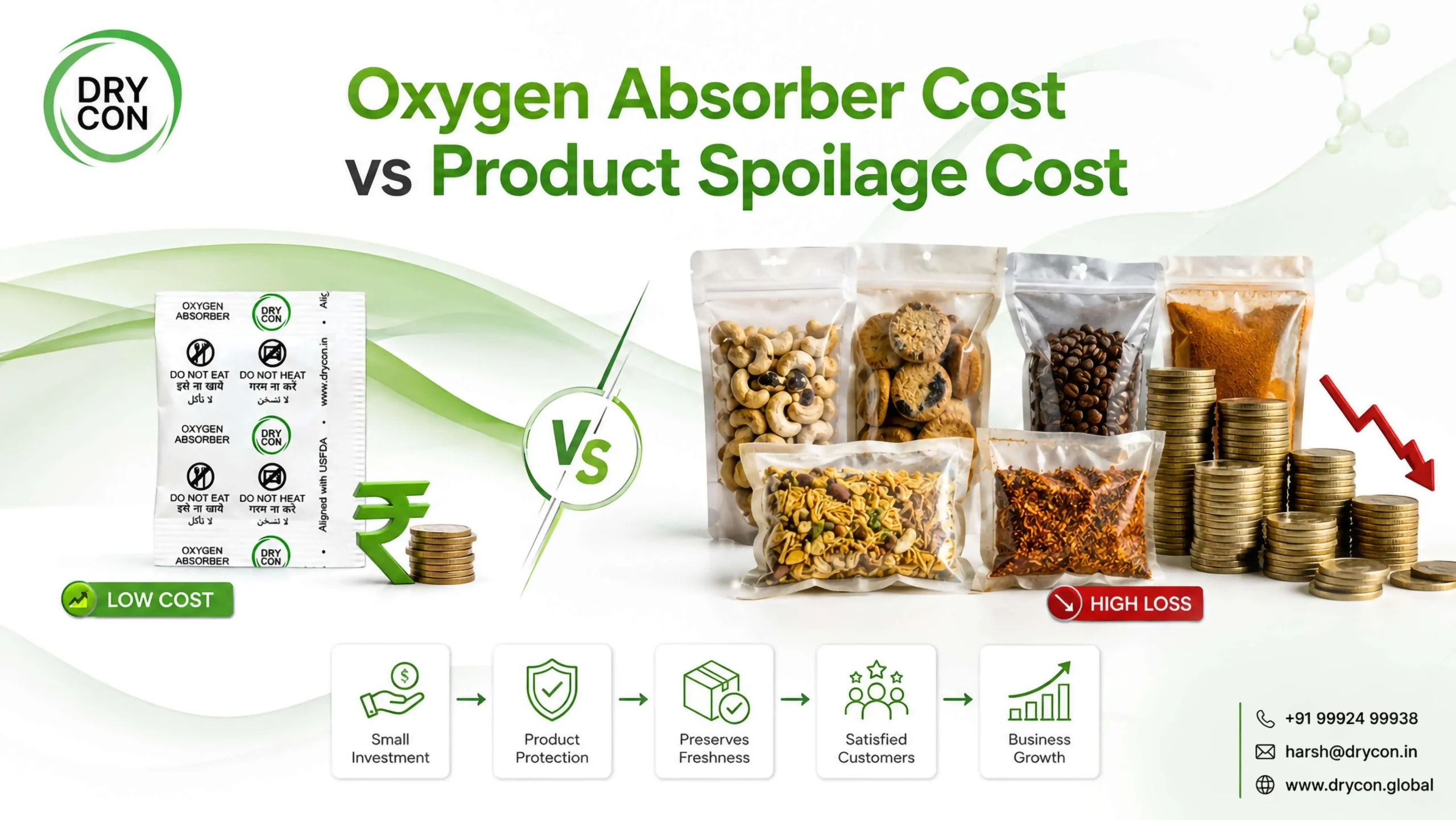




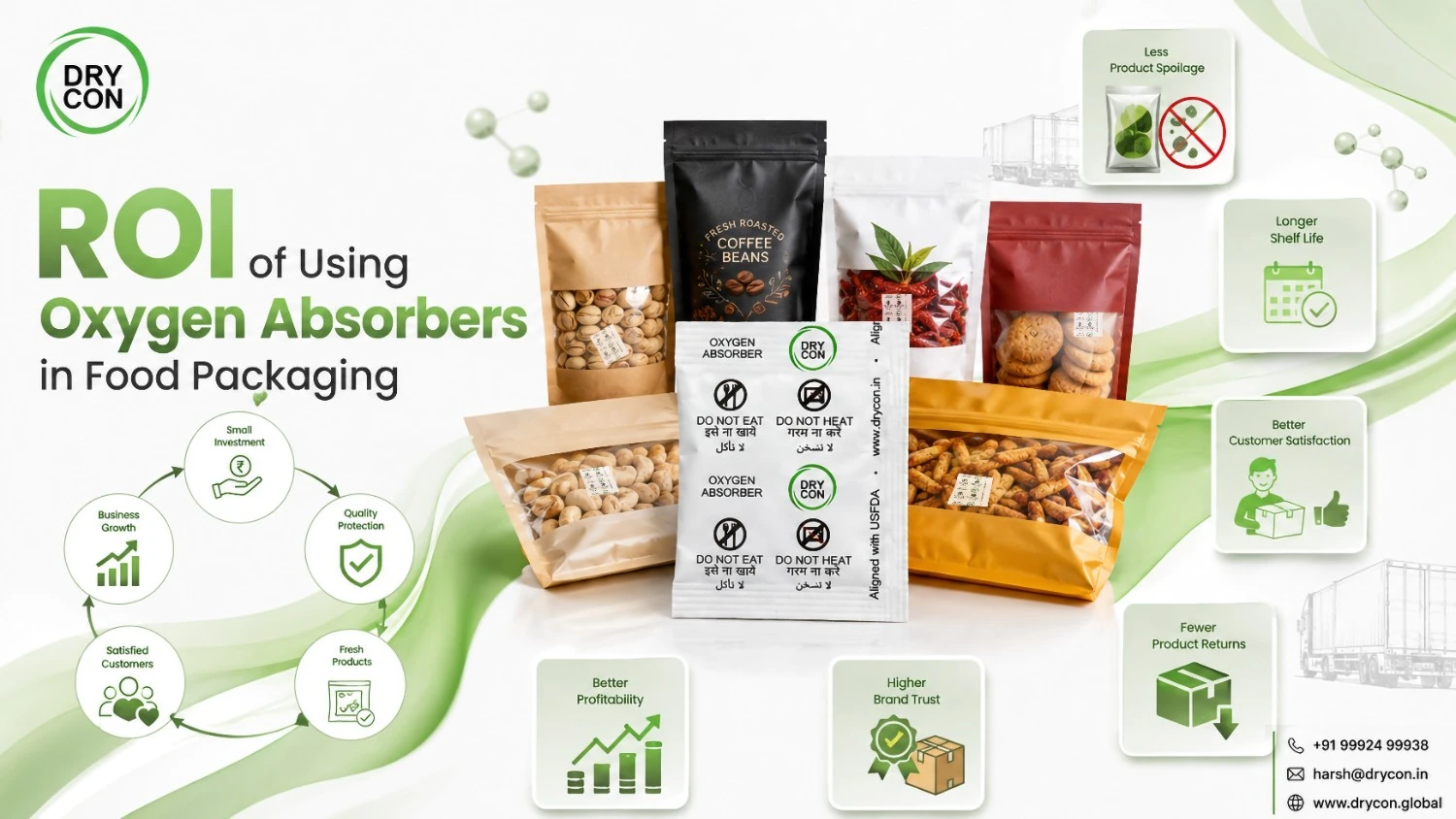
For a food manufacturer, an oxygen absorber may cost only a small amount per pack. The cost of a rejected shipment, rancid product, mould growth, or customer complaint can be much higher. That is why the ROI of using oxygen absorbers in food packaging should not be measured only by the sachet price. The better question is: How much product loss can the packaging system prevent compared with its added cost?
Oxygen is a major cause of oxidation and quality loss in many foods. Normal air contains roughly 21% oxygen, and managing it really is one of those key things for food packaging design. For dry fruits , nuts, snacks, bakery products, spices, grains, and other oxygen-sensitive dry foods, oxygen absorbers can help cut down the leftover oxygen inside a well sealed pack.
Still, it’s not some universal fix. Fresh fruit and vegetables are living products that continue to respire after packing, so their packaging needs careful control of oxygen and carbon dioxide exchange, which can be a bit finicky. The real ROI comes from matching the absorber, pack, product, and distribution conditions correctly.
How to Calculate Return of Investment (ROI) of Oxygen Absorbers?
A simple ROI calculation starts with the cost of the oxygen absorber and compares it with the losses it can help avoid. A practical formula is:
Oxygen absorber ROI = (Avoided losses − absorber and implementation cost) ÷ absorber and implementation cost × 100
Consider these cost areas:
- Product spoiled or downgraded
- Customer returns
- Export shipment rejections
- Discounts on ageing stock
- Disposal costs
- Repacking costs
- Customer complaints and replacements
- Lost sales caused by short shelf life
- Additional packaging or handling costs
| Important: Do not calculate ROI from absorber price alone. Calculate it against the value of product protected. |
ROI of Oxygen Absorbers in Food Packaging
The ROI of using oxygen absorbers in food packaging depends on how sensitive the product is to oxygen and how much oxygen remains inside the package.
Oxygen absorbers work by removing residual oxygen from a sealed package. Iron-based systems are commonly used for this purpose. USDA research identifies oxygen scavenger packets as an active packaging technology used to control oxygen in food packages.
The strongest business case usually exists where oxygen can cause:
- Rancidity in products containing fats or oils
- Loss of flavor or aroma
- Color changes
- Oxidative quality deterioration
- Mould growth in suitable dry-food conditions
- Shorter marketable shelf life
The absorber must work with a suitable oxygen-barrier package. A poor seal or high oxygen transmission through the packaging material can reduce the benefit. USDA notes that oxygen transmission rate and oxygen content are important measurements in food package design. So the ROI is really a package-system ROI, not simply a sachet ROI.
Do Oxygen Absorbers Save Money?
Yes, they can, when oxygen is a significant cause of product loss. But the savings depend on the product and packaging system.
Oxygen absorber packets do not automatically create a profitable result. If the product is only slightly sensitive to oxygen, or when the packaging already manages oxygen really well , then the extra expense might end up delivering rather little value so it feels kind of pointless. In other words it is not always an instant win.
A good assessment asks:
- What causes current product deterioration?
- How much product is affected?
- What is the value of the affected product?
- What oxygen level is required?
- Is the current packaging sufficiently airtight?
- What absorber capacity is appropriate?
- Can the result be confirmed through testing?
This approach prevents manufacturers from buying either too little or too much absorber capacity.
Also Read : Oxygen Absorber Cost vs Product Spoilage Cost: Which Saves More?
Cost Savings From Oxygen Absorbers
The most visible food packaging cost savings often come from reduced product loss. But there can be secondary savings too.
- Less rejected stock – If oxidation causes quality failures, better oxygen control can reduce the quantity that needs to be rejected or downgraded.
- Fewer customer complaints – Stable product quality can reduce complaints linked to stale taste, rancidity, colour changes, or other oxygen-related deterioration.
- Better inventory flexibility – A longer validated shelf life can give manufacturers more time to sell, distribute, or export stock.
- Lower waste – Every kilogram of food that remains saleable represents avoided waste and recovered product value.
- Better export economics – For exporters, product protection must continue during warehousing, port handling, transit, customs clearance, and distribution.
That makes shelf life a commercial asset, not simply a technical specification.
Oxygen Absorber Investment for Food Manufacturers
The right oxygen absorber should be treated as a packaging component, not a commodity purchased only on unit price. Before approving a supplier, procurement and QA teams should review:
- Absorption capacity
- Sachet size
- Intended food application
- Packaging compatibility
- Seal integrity
- Storage conditions before use
- Shelf life of unused absorbers
- Batch identification and traceability
- Quality testing
- Supply capacity
- Technical support
- Export documentation requirements
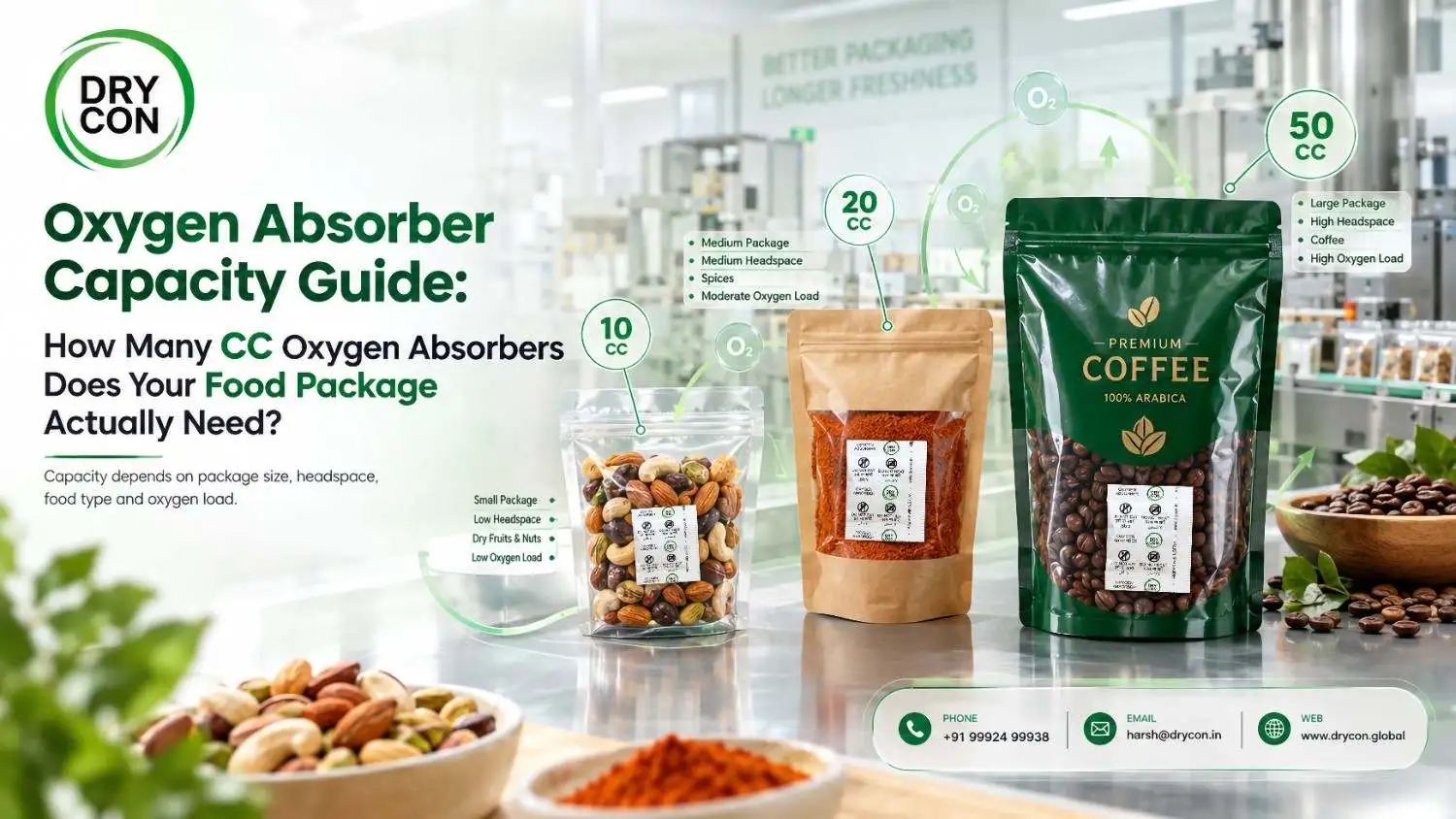
The correct capacity for an oxygen absorber can be selected by considering the actual package volume, product characteristics, residual oxygen, packaging barrier, and expected oxygen ingress. It should not be selected simply because a larger sachet appears safer.
Also Read : Moisture Control for Food Products During Shipping
Benefits of Oxygen Absorbers for Food Businesses
The main oxygen absorber benefits are linked to controlling oxygen-driven deterioration. For suitable dry foods, they can support:
- Better protection against oxidation
- Longer validated shelf life
- Improved flavor and aroma retention
- Reduced quality deterioration
- Lower product waste
- Better protection during long distribution cycles
- More consistent product quality
They are especially meaningful for oxygen- sensitive items like dry fruits, nuts, snacks, baked goods, spices, and other dehydrated packaged foods.
An oxygen absorber manages the oxygen content, while the desiccant manages moisture. A product might need just one of them, the other, or even both, depending on how it fails or behaves over time.
Reducing Food Spoilage With Oxygen Absorbers
Oxygen affects food in several ways. It can promote oxidation and support aerobic spoilage processes. USDA and FDA materials recognize oxygen control as an important part of food preservation packaging and reduced-oxygen packaging.
However, reduced oxygen packaging also needs proper food safety controls. It should never be treated as a replacement for validated processing, hygiene, temperature control, or appropriate storage. For dry foods, the packaging system should be assessed as a whole. That includes:
- Product moisture and water activity
- Oxygen sensitivity
- Initial oxygen in the headspace
- Packaging oxygen barrier
- Seal quality
- Absorber capacity
- Storage temperature
- Distribution duration
- Expected oxygen ingress
This is especially important for food exporters. A package that performs good in a local warehouse might meet very different conditions during a long international shipment, like yeah there is air movement, temperature swings, and handling that is not the same.
Also Read : Oxygen Absorbers for Dry Fruit Packaging | Buyer’s Guide
Shelf Life Extension ROI
Shelf life extension creates ROI only when the extra shelf life has commercial value. For example, an additional validated shelf-life window may help a manufacturer:
- Reach distant markets
- Reduce ageing inventory
- Reduce stock write-offs
- Manage production batches more efficiently
- Handle longer export transit
- Improve distributor inventory planning
Do not promise a fixed number of additional months without product-specific testing. Shelf life is affected by the product, packaging, storage conditions, processing, and distribution environment. A proper shelf-life study should measure relevant quality attributes over time.
QA checkpoint:
Establish a baseline first. Compare the current package with the oxygen-absorber package under defined storage conditions before making a commercial shelf-life claim.
Packaging ROI for Food Manufacturers
The broader food packaging ROI comes from choosing a packaging system that protects the product without adding unnecessary cost. A reliable system balances:
Product sensitivity + package barrier + absorber capacity + seal quality + distribution conditions
This is where packaging engineers and QA managers should work together. A cheaper absorber may have a lower purchase price. That does not mean it has the lower total cost. The goal is not to choose the supplier with the lowest quotation. The goal is to choose the supplier that gives predictable performance at the required production scale.
Oxygen Absorbers for Export Packaging
Export packaging adds another layer of risk. Products may spend weeks in warehouses, containers, ports, distribution centres, and retail channels. Temperature changes can also affect packaging performance and product stability. For exporters, the buying decision should therefore include:
- Transit duration
- Destination climate
- Expected storage conditions
- Package dimensions
- Headspace volume
- Packaging oxygen barrier
- Seal integrity
- Required absorber capacity
- Master-pack storage of unused sachets
- Batch traceability
- Export documentation
DryCon provides oxygen absorber solutions for food packaging and describes applications including dry fruits, bakery products, spices, snacks, and other oxygen-sensitive packaged products.
For international shipments, procurement teams should also confirm destination-market requirements and applicable food-contact rules with their regulatory team or importer.
Also Read : Oxygen Absorbers for Bakery Packaging: Complete Buying Guide
Why Manufacturer Selection Matters?
An oxygen absorber packet is only useful if it reaches the package in the right condition and performs as expected. Unused sachets must be protected from premature exposure to oxygen. DryCon recommends keeping unused oxygen absorbers in sealed master packaging and avoiding opening or puncturing sachets before use. Manufacturers should also establish clear batch controls. For every production lot, retain records for:
- Supplier and batch number
- Absorber specification
- Purchase quantity
- Production date, where applicable
- Incoming quality checks
- Packaging line usage
- Product batch
- Storage conditions
- Complaint or failure records
This makes troubleshooting much easier if a quality issue appears later.
A Practical Buying Checklist
- Define the oxygen-related failure you are trying to prevent.
- Measure package size and headspace.
- Check packaging oxygen barrier and seal integrity.
- Select absorber capacity based on actual requirements.
- Confirm food-grade suitability for the intended application.
- Review batch identification and traceability.
- Establish storage requirements for unused sachets.
- Conduct package-level testing before full-scale rollout.
- Validate shelf life under realistic storage conditions.
- Review monthly consumption and supply capacity.
- Compare total cost, not only price per sachet.
Also Read : Foods That Need Oxygen Absorbers (and Foods to Avoid)