



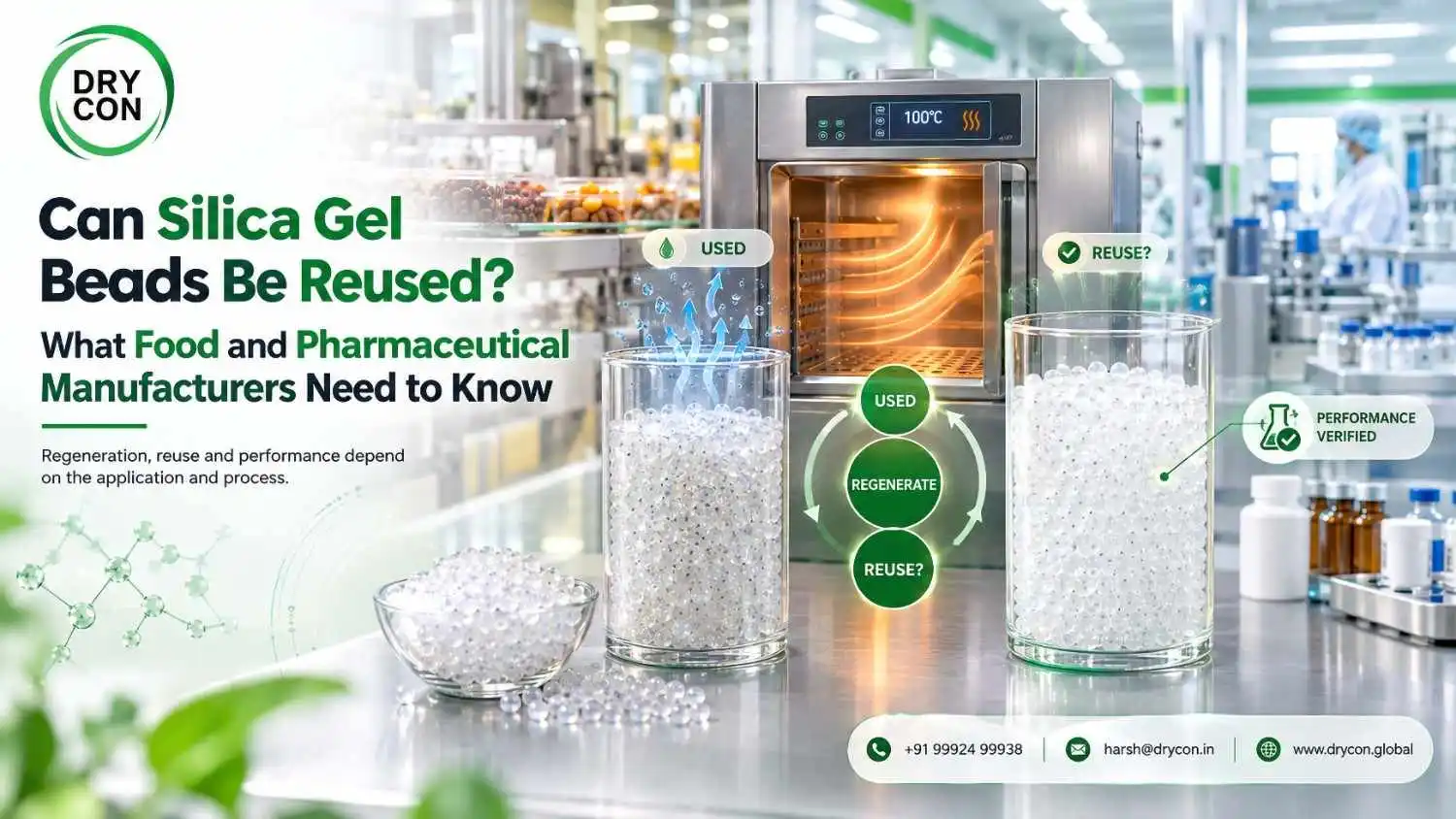
If you are wondering, could silica gel beads be reused? The answer is yes! But only if you get the right conditions in the end. Silica gel itself is kind of a porous drying agent, like it has lots of tiny cavities inside. Those cavities grab water vapor on its internal surface and hold it there. So yes, reuse can work, but you just need to manage the moisture properly. When the moisture load is taken away using controlled heating, the gel can regain a large portion of its adsorption ability.
Still, that does not mean that any used silica gel sachet should be regenerated and then put back into food packaging or pharmaceutical packaging, as if it was always clean. No. The real thing industrial buyers usually want to know is more pointed, like:
Can this specific silica gel be regenerated? And once it is regenerated can it keep meeting the needed performance, hygiene, packaging, and compliance requirements. That difference matters a lot.
Can Silica Gel Beads Be Reused After Absorbing Moisture?
Yes. Silica gel beads can be reused after they take in moisture, but only if the beads are still good for regeneration and they haven’t been contaminated, or physically damaged during the process. In general silica gel does not normally react chemically with the water it absorbs. Instead, water molecules are held inside the porous structure and also clinging on the surface.
By heating, you drive out a good amount of that trapped moisture. People call it silica gel regeneration, silica gel reactivation, or re-drying , depending on who you ask. But, reuse is not automatically right for every use case, so you cannot just assume. For a warehouse moisture-control unit, reuse may be practical. For a pharmaceutical packaging system, the decision requires much tighter control. The important factors are:
- Original silica gel grade
- Initial adsorption capacity
- Moisture exposure
- Contamination risk
- Regeneration process
- Physical condition of the beads
- Sachet or container condition
- Post-regeneration moisture content
- Required packaging performance
So, can silica gel beads be reused? Technically yes. Commercially and from a quality standpoint, the answer depends on the application.
What Happens to Silica Gel When It Becomes Saturated?
When silica gel absorbs moisture, the adsorption sites it has available start getting taken up, basically they become filled. So, the moisture absorption capacity drops off as the material gets closer to its moisture loading limit, like it is running out of room. But this doesn’t mean the silica gel is permanently damaged or ruined, not really.
One fairly decent way to picture it is:
dry silica gel → exposure to moisture → adsorption → saturation → regeneration → reuse.
The actual adsorption capacity varies, depending on temperature, relative humidity, particle properties, pore geometry , and even the exact silica gel grade, kind of like it matters more than people think.
USP guidance too remarks on moisture content , surface area, adsorption capacity and particle size as the main performance characteristics for desiccants, especially when used in pharmaceuticals. That’s why shopping for silica gel only by its price per kilogram can be kind of misleading. A lower-cost material with lower usable capacity may require more material per package.
Also Read : AIHUA vs Standard Silica Gel Packaging: Best for Food & Pharma Safety
Can Silica Gel Be Regenerated and Reused?
Yes. Silica gel can be regenerated and reused when the material and application permit it. The purpose of regeneration is to remove the water previously adsorbed by the silica gel. This process does not create new adsorption sites. It restores sites that were occupied by water. That difference is important.
A regenerated silica gel may perform close to its original condition, but performance should not be assumed without testing. For commercial packaging, especially food and pharmaceutical packaging, the supplier should be able to explain:
- What grade of silica gel is being supplied?
- What is its moisture adsorption capacity?
- How is capacity measured?
- What is the recommended storage condition?
- Is the material virgin or recycled?
- Is the sachet material suitable for the application?
- How is batch consistency controlled?
These questions are often more useful than asking whether a supplier simply offers “reusable silica gel.”
How to Regenerate Silica Gel Beads?
The basic principle of silica gel beads regeneration is controlled heating. When the heating part happens, it sort of pushes the adsorbed moisture out from the pores. After that, the beads get cooled down and kept away from ambient humidity until they’re ready for use, or at least until you can safely handle them.
The exact regeneration temperature, and how long it lasts, really varies with a bunch of factors, like the grade of the material, the particle size, the moisture loading, the equipment you’re using, and what the manufacturer’s speculation sheet says. So there isn’t one single temperature that you can just apply to every silica gel product out there.
In fact, a lot of commercial silica gels are often regenerated in about the 100°C to 150°C neighborhood. Still, the packaging materials, indicators, sachets, binders, and some other components can have their own, different temperature limits. Because of that, don’t just assume the silica gel sachet itself can go straight into an oven, even if it “seems” like it should. For industrial use, the safer approach is:
- Confirm the silica gel grade.
- Check the manufacturer’s regeneration specification.
- Determine whether the sachet material can tolerate the process.
- Regenerate under controlled conditions.
- Cool the material in a dry environment.
- Measure or verify moisture content where required.
- Store the regenerated material in sealed, moisture-resistant packaging.
USP packaging guidance also recognizes the need to test desiccants either before moisture loading or after regeneration when evaluating desiccant performance.
Also Read : Silica Gel Pouch vs Oxygen Absorbers: Which Protects Better?
Does Regenerated Silica Gel Perform Like New Silica Gel?
It can perform close to its original capacity, but this should not be treated as a permanent guarantee. The number of regeneration cycles, heating conditions, contamination, physical handling, and storage can affect performance. A regenerated silica gel may therefore have lower silica gel adsorption capacity than unused material.
For general industrial storage, this difference may be acceptable. For pharmaceutical packaging, it may not be. This is where laboratory testing becomes useful. A supplier or manufacturer should be able to establish a defined acceptance limit for:
- Moisture content
- Adsorption capacity
- Particle size
- Appearance
- Physical integrity
- Sachet integrity
- Relevant chemical or microbiological requirements
The question should not be, “Can we reuse this?”, it should be, “Does this regenerated material still meet our defined specification?”.
How Many Times Can Silica Gel Be Regenerated?
There is no universal number of regeneration cycles for all silica gel. Claims such as “100% reusable” or “indefinitely reusable” should therefore be treated carefully in industrial procurement. Silica gel can often withstand repeated adsorption and regeneration because the basic adsorption process is reversible. But repeated heating and handling can affect:
- Bead strength
- Dust formation
- Pore performance
- Indicator performance
- Packaging material
- Contamination levels
- Final adsorption capacity
The correct cycle limit should come from application testing rather than a generic number printed on a product page. For critical packaging, define a maximum number of cycles and a minimum acceptable adsorption capacity before reuse.
What Factors Affect Silica Gel Regeneration and Reuse?
1. Type and grade of silica gel – White, blue, orange, and other indicating or non-indicating grades can have different specifications. A food grade silica gel desiccant should not automatically be treated as interchangeable with a technical-grade material. The same applies to silica gel for pharmaceutical packaging.
2. Moisture exposure – The amount of moisture absorbed affects regeneration requirements. A lightly loaded desiccant and a heavily loaded desiccant should not be assumed to require identical processing.
3. Regeneration conditions – Temperature, time, airflow, equipment, and cooling conditions all matter. Overheating can damage some forms of packaging or affect indicators.
4. Contamination – This is one of the biggest concerns. Silica gel used around chemicals, oils, odors, dust, solvents, or other contaminants should not automatically return to food or pharmaceutical use. Regeneration removes moisture. It does not necessarily remove every contaminant.
5. Physical degradation – Repeated handling may cause breakage or dust. Fine particles can change sachet behavior and may create packaging concerns.
6. Adsorption capacity – The final question is performance. If the regenerated material no longer provides enough silica gel moisture absorption, reuse may create false savings.
Also Read : Essential Role of Silica Gel Packets in Packaging for Moisture Control
Can Regenerated Silica Gel Be Used for Food Packaging?
The answer requires even more care. Desiccants are fairly used in pharmaceutical packaging for controlling humidity in a very direct kind of way. The USP material points out that silica gel is among the commonly used desiccants for this purpose, and it also says the adsorption capacity really isn’t fixed , it depends on a mix of things—like time , relative humidity, temperature, and the properties tied to the material itself. However, regenerated silica gel for pharmaceutical packaging should not be treated as equivalent to qualified new material without evidence.
Pharmaceutical packaging requires control of the complete system. That includes the desiccant, container, closure, sachet or canister, moisture exposure, storage, and stability requirements. A regenerated material may therefore be technically functional but unsuitable for a validated pharmaceutical process. For critical applications, QA should approve the reuse procedure before production use.
Is Recycled Silica Gel Safe for Food Packaging?
This needs a clear distinction. Recycled silica gel and regenerated silica gel are not the same thing. Regeneration means drying the same silica gel after it has absorbed moisture. Recycling may refer to recovery or reuse of material through a separate manufacturing or material-recovery process. These processes should never be treated as interchangeable.
For food packaging, the buyer should ask exactly what the supplier means by “recycled.” Some suppliers explicitly state that their food and pharmaceutical desiccants use virgin silica gel rather than recycled material. This reflects a wider industry focus on raw-material control for sensitive applications.
What Is the Difference Between Recycled, Regenerated and Reusable Silica Gel?
| Term | Meaning | Main Concern |
|---|---|---|
| Regenerated silica gel | Used silica gel that has been dried again | Remaining adsorption capacity |
| Reusable silica gel | Material designed or approved for repeated use | Defined reuse conditions |
| Recycled silica gel | Material recovered through a recycling process | Source, purity and suitability |
| New silica gel | Unused silica gel supplied in its original qualified condition | Batch consistency and specification |
NOTE: For procurement teams, this distinction is essential. A supplier saying “reusable” does not automatically mean the material is suitable for reuse in regulated packaging.
Can Silica Gel Sachets Be Reused?
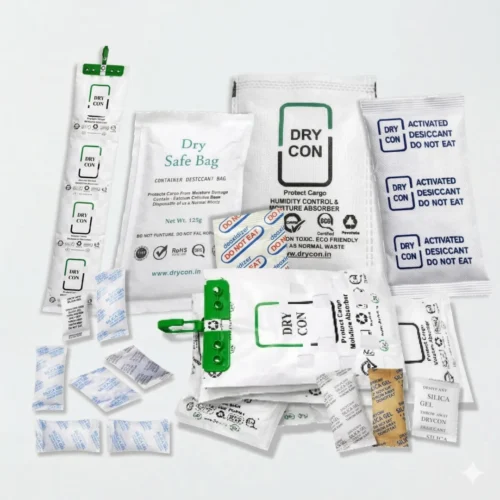
The silica gel inside a sachet may be regenerable, but the sachet itself may not be suitable for repeated use. This is often overlooked. The outer material controls how moisture enters the sachet. Seals can also weaken through heating, handling, or repeated use. A reusable silica gel beads placed inside a damaged sachet really isn’t a solid, dependable moisture control option
For commercial packaging it’s usually smarter to look at the desiccant AND the sachet together as basically one system, not two separate ideas, because the interactions matter.
How Do You Reactivate Silica Gel?
To reactivate silica gel, you remove the moisture it absorbed by doing controlled drying, following the material supplier’s instructions for temperature time and method. Also don’t just trust the color on its own. An indicating silica gel can suggest moisture has been taken in, but the shade doesn’t give you a true quantitative readout of how much adsorption capacity is left
After silica gel reactivation, the recharged material should be kept away from ambient humidity. That part is very important, especially in humid production zones. A regenerated desiccant can start taking up water again before it even gets near the packaging line, which kind of defeats the point.
What Happens When Silica Gel Absorbs Too Much Moisture?
When silica gel is heavily loaded with water, the remaining adsorption capacity drops It doesn’t suddenly become hazardous or chemically change into something else just because it has absorbed water. The real, hands-on problem is performance. If the package still needs moisture protection, but the desiccant has almost no capacity left, product quality can be impacted.
Because of that, the amount of desiccant should be calculated based on the product moisture load, the packaging type, how long storage lasts, transport conditions, and the level of humidity it’s expected to face during handling.
| A Practical Procurement Scenario |
|---|
| For a food manufacturer getting ready for a long export shipment, the procurement team basically analyses on getting suppliers. Say they ended up finding two silica gel suppliers. One of them is offering a much lower price, and claims the beads can be regenerated over and over, repeatedly.
The other supplier seems a bit more careful, they want to know the product moisture content first, plus the packaging size too. Then they ask about how long the shipping duration is, the climate in the destination place, what storage conditions are planned, and finally how much desiccant is actually required. The first approach looks cheaper. The second approach is actually asking the questions that determine whether the desiccant will work. A common issue in moisture-control procurement is treating desiccant as a commodity rather than as part of the packaging system. In an anonymized composite example based on this type of situation, a buyer was considering a lower-cost desiccant because the material looked similar and the quoted absorption figure appeared acceptable. The technical discussion changed once the application was reviewed. The concern was not whether the beads could absorb moisture. The concern was whether the selected quantity, sachet construction, storage condition, and expected humidity exposure were aligned with the shipment. That is the type of distinction an experienced moisture-control supplier should help a buyer identify before purchase. REMEMBER: A cheaper desiccant is not cheaper if the moisture protection is undersized. |
How to Determine If Regenerated Silica Gel is Actually Good Enough for your Application?
Before you say yes and approve silica gel reuse, run through this short checklist.
Material
- What silica gel grade was originally supplied?
- Is the silica gel indicating or non-indicating?
- Is the silica gel food, pharmaceutical, or technical grade?
- Is the raw material virgin or recycled?
Performance
- What was the original adsorption capacity?
- What is the capacity after regeneration?
- What test method is used?
- What is the acceptable minimum?
Exposure
- What moisture did the material encounter?
- Was it exposed to chemicals, oils, odours, dust, or other contaminants?
- Was it used inside a controlled packaging environment?
Regeneration
- What temperature is specified?
- What drying time is required?
- Can the sachet tolerate the process?
- How is the regenerated material cooled and stored?
Quality
- Is every batch traceable?
- Are test records available?
- Is moisture content checked?
- Is the material inspected for dust, breakage, and contamination?
Packaging
- Is the sachet material suitable?
- Is the seal intact?
- Does the sachet allow adequate vapour transmission?
- Is the format suitable for automated or manual packing?
For food and pharmaceutical applications, this evaluation should form a part of the QA process.
Should Manufacturers Reuse Silica Gel or Use New Material?
For general industrial applications, regeneration can make sense when the material is clean, suitable, and performance is verified. For food and pharmaceutical packaging, the decision should be based on documented risk assessment and application requirements. New material offers a simpler starting point for controlling raw-material history and performance.
Regenerated material may be practical in controlled systems where reuse has been validated. The key is not whether new or regenerated material sounds better. The key is whether the selected material consistently provides the required moisture protection.
What Should Buyers Ask Silica Gel Manufacturers?
Before placing a large order, ask the supplier for more than a price. A reliable supplier should be able to discuss:
- Silica gel grade
- Particle or bead size
- Moisture adsorption capacity
- Test conditions used for capacity
- Moisture content
- Sachet material
- Sachet weight tolerance
- Storage conditions
- Batch traceability
- Application-specific documentation
This is particularly useful when comparing silica gel manufacturers and international desiccant manufacturers. Do not compare suppliers only by price per sachet. Compare the actual moisture-control specification.