



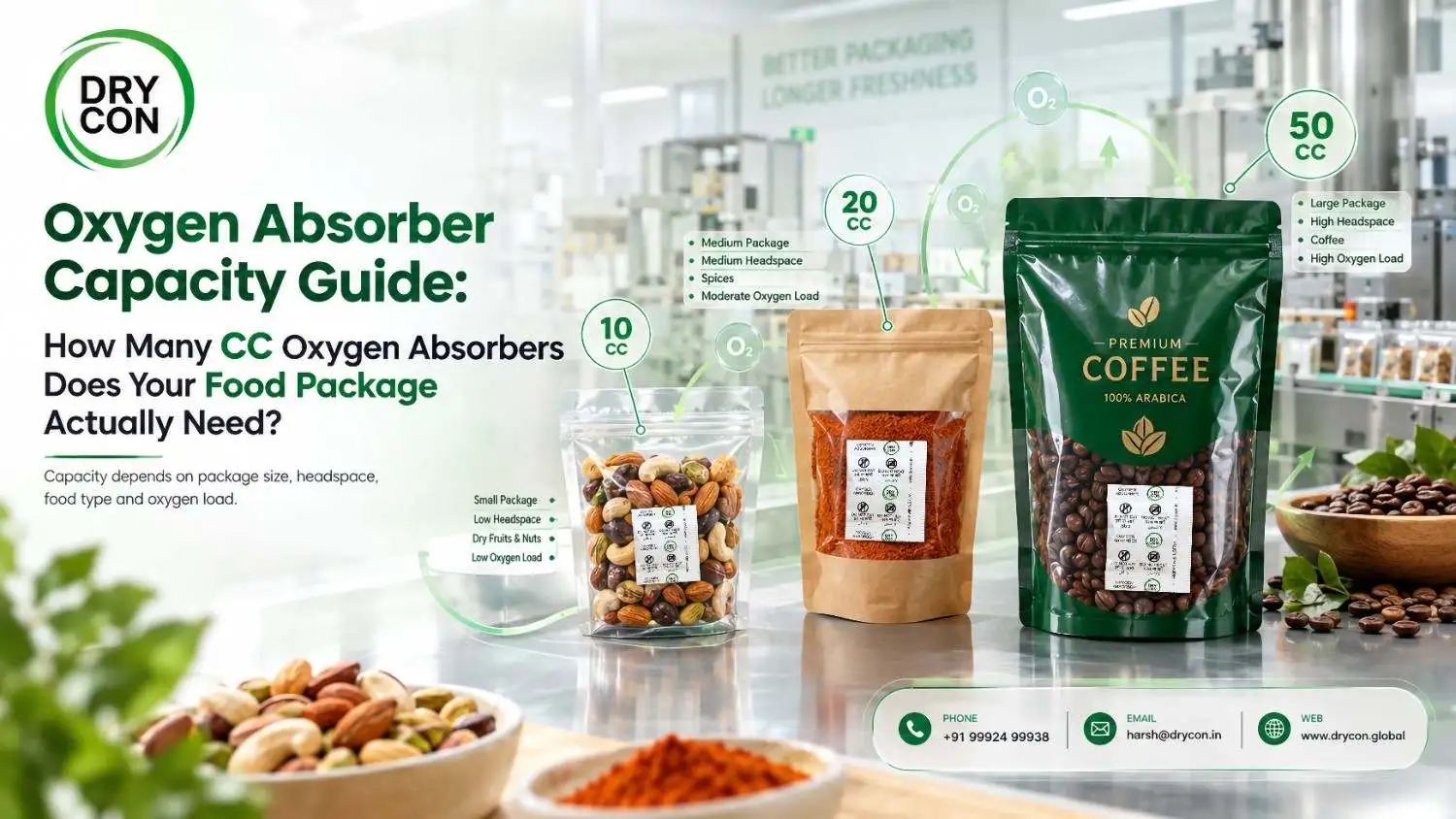
Choosing the right oxygen absorber capacity really isn’t as straight forward as just matching a sachet to the food weight. A 1 kg pack of rice, nuts, dried fruit, or spices can end up, needing totally different absorber sizes. It sort of depends on the headspace volume, packaging material, the amount of residual oxygen that’s really inside, the actual product condition, the shelf life target, and even how much oxygen sneaks in through the package over time.
This is important because an undersized absorber may not protect properly. But a bigger absorber than you need also wastes money and still doesn’t fix the real issue, which is the packaging system behavior. So for food manufacturers, exporters, packaging procurement teams, and QA managers the better question isn’t only, “How many cc do I need?” It’s more like, “How much oxygen must this packaging system actually control?”
What Does an Oxygen Absorber Do in Practice?
An oxygen absorber is an active packaging component made to remove oxygen from a sealed package. Many commercial sachets use iron-based systems. The iron reacts with oxygen and binds it as iron oxide. This reduces oxygen available for oxidation and other oxygen-related quality problems.
This can help protect products such as:
- Nuts and dry fruits
- Spices and herbs
- Rice and grains
- Bakery products
- Snacks
- Dry mixes
- Coffee and other oxygen-sensitive dry foods
However, a oxygen absorber does not just replace good packaging, it doesn’t really do that. A package still has to do its job with decent barrier properties and reliable seals. Oxygen can keep creeping in even when you add a sachet, especially if the package has high oxygen transmission or if the sealing is less than perfect. Research on oxygen scavengers also keeps coming back to the fact you need to think about package permeability, headspace, and the oxygen that is already associated with the food product.
Quick TipTry to treat the absorber and the package as one system. Picking a larger sachet will not fix a weak oxygen barrier, nor will it correct a leaking seal, so don’t assume bigger equals better. |
So, How much oxygen absorber do i need for food?
There is no one single oxygen absorber size that fits every food package or every situation. The required oxygen absorber capacity depends mainly on:
- Package headspace
- Oxygen already inside the package
- Air trapped between food particles
- Oxygen dissolved or associated with the product
- Oxygen entering through the packaging material
- Expected shelf life
- Packaging seal quality
- Storage and transport conditions
Air actually has about 20.9% oxygen by volume. so, if a package has 100 cc of air sitting in the headspace, then that headspace has around 20.9 cc of oxygen at first, before you think about other ways oxygen could be coming in.
That is why package weight alone cannot determine absorber capacity.
A 1 kg bag with a small, tightly filled headspace may have very different oxygen requirements from a 1 kg bag with a large empty space.
Also Read : Oxygen Absorber ROI: Cut Food Packaging Costs & Waste
How to Calculate Oxygen Absorber Size?
A practical starting point is to calculate the oxygen present in the package headspace. Basic calculation is,
Headspace oxygen = Headspace volume × 20.9%
For example: 500 cc headspace × 0.209 = approximately 104.5 cc oxygen
This gives you the oxygen in the initial headspace air. But this is not the final oxygen absorber requirement. You should also account for:
- Oxygen trapped between food pieces
- Dissolved or absorbed oxygen
- Oxygen transmission through the package
- Seal leakage or poor sealing
- Required protection period
- Performance of the selected absorber
This is why a simple oxygen absorber calculator based only on pack weight can be misleading. A more useful oxygen absorber capacity calculation. For commercial packaging, think of the requirement as:
Required capacity ≈ initial oxygen + product-associated oxygen + expected oxygen ingress + safety allowance
The exact safety allowance should come from product and package testing rather than an arbitrary percentage. For high-value exports, laboratory validation is far safer than choosing an absorber from a generic oxygen absorber size chart.
How to Calculate Oxygen Absorber Capacity?
to absorb, commonly expressed in cc or mL of oxygen. Therefore, 1 cc oxygen absorber capacity = approximately 1 mL of oxygen absorption capacity.
A 50 cc absorber is designed to absorb about 50 cc of oxygen under the manufacturer’s specified test conditions. It does not mean that the sachet is suitable for a 50 cc package.
For example, a package can have:
- 100 cc headspace
- 21 cc initial oxygen
- Additional oxygen trapped around the product
- Oxygen entering through the film during storage
The actual requirement can therefore exceed the initial headspace calculation. This distinction is one of the most common areas of confusion during procurement.
Also Read : Oxygen Absorber Cost vs Product Spoilage Cost: Which Saves More?
How Many CC Oxygen Absorbers Do I Need?
There is no scientifically sound rule such as “50 cc for every 1 kg.” The correct oxygen absorber quantity is based on oxygen load, not simply food weight. A useful way to compare common sizes is:
| Absorber Capacity | General Use Consideration |
|---|---|
| 20 cc | Small packs and low oxygen load |
| 30 cc | Small to medium packs |
| 50 cc | Medium packs with higher oxygen load |
These are capacity categories, not universal food-weight recommendations. For example, DryCon provides oxygen absorber options including 20 cc, 30 cc, 50 cc and 100 cc formats for food packaging applications. But before procurement, ask the supplier for the actual rated capacity and test basis rather than selecting by sachet size alone.

Oxygen Absorber Size for Food Packaging
Packaging is one of the most important parts of oxygen absorber selection. A good oxygen absorber works best when the package provides a suitable oxygen barrier and a reliable seal. If oxygen continuously enters the package, the absorber may become exhausted before the intended shelf life ends. Consider:
- Film structure
- Oxygen transmission rate
- Package volume
- Seal integrity
- Closure design
- Headspace
- Storage temperature
- Expected shelf life
FSSAI’s packaging regulations also require oxygen absorber for food packaging materials to be safe and suitable for their intended use. For export products, packaging should also be assessed against the destination market’s requirements.
1. Oxygen Absorber Size for 1 kg Food
A 1 kg pack does not automatically require a particular oxygen absorber capacity. Consider two 1 kg packs.
Pack A: The food is densely filled in a high-barrier pouch with limited headspace.
Pack B: The same food is placed in a larger pouch with significant headspace.
Pack B contains more air. Therefore, its initial oxygen load can be much higher. The food itself also matters. Nuts contain oils that are sensitive to oxidation. Dried fruit can have different moisture and oxygen interactions.
Rice and spices have different particle sizes and packing densities. So, when someone asks, “How many cc oxygen absorber do I need for 1 kg?”, the correct response is, “It depends on the complete package design.”
2. Oxygen Absorber Size for Nuts
Nuts are a common application because oxygen can contribute to oxidative changes in their fats, leading to rancidity and quality loss. For nuts, review:
- Nut type
- Fat content
- Pack weight
- Headspace
- Film barrier
- Shelf-life target
- Storage temperature
- Expected export duration
Do not choose a 20 cc, 30 cc, or 50 cc absorber simply because another nut brand uses it. Run the oxygen calculation for your own package. For premium nuts and dry fruit exports, the cost of proper oxygen control is usually small compared with the cost of rejected or degraded stock.
3. Oxygen Absorber Size for Rice
Rice typically needs a slightly different assessment than oily stuff like nuts, honestly it kind of behaves different. A few key variables show up, like package volume, grain density, headspace, the leftover air, packaging barrier, and the intended storage period. For rice that is sold in larger bags, the headspace plus the overall package surface area can become kind of important, more than you might expect.
So a procurement team should hand the absorber manufacturer the actual pack dimensions, the product weight, the package material, and the shelf-life target, without relying on assumptions. With that in place, the supplier can recommend a fitting oxygen absorber capacity, instead of just guessing from the kilogram weight alone.
4. Oxygen Absorber Size for Dried Fruits
Dried fruits can be particularly sensitive to both oxygen and moisture. Oxygen absorbers address oxygen. They do not perform the same function as silica gel or another desiccant. The correct solution may require controlling both risks, depending on the product and packaging system.
For example:
Oxygen problem → oxygen absorber
Moisture problem → desiccant
Using both can be appropriate when each has a clear purpose and the package design supports their use.
Also Read : Best Oxygen Absorbers for Dry Fruit Packaging: A Buyer’s Guide
5. Oxygen Absorber Size for Spices
Spices can lose good quality kind of fast , due to oxidation, aroma going away, color shifts , and a bunch of other storage effects , you know. The oxygen absorber capacity that is needed really depends on things like the pouch size or container size , the amount of headspace, the barrier strength, the product traits, and the storage period.
Also Read : How Oxygen Absorbers Preserve Spice Aroma and Color?
For a spice exporter, that same 1 kg batch might end up requiring a different oxygen absorber if it’s packed in a small high-barrier pouch , compared with a larger container. This is why experienced oxygen absorber manufactures should ask questions about the whole packaging system first, before quoting a quantity.
Why Does Manufacturer Selection Matters?
Price can look attractive when buying oxygen absorbers in large quantities. But the cheapest sachet is not necessarily the lowest-cost solution. Some buyers are willing to compromise absorber quality to reduce the per-piece price. That can create a much larger cost later through inconsistent protection, rejected batches, product complaints, or failed shelf-life testing. A reliable supplier should be able to discuss capacity, storage, handling, batch information, and application suitability.
Feature |
Reliable Manufacturer |
Generic Supplier |
| Capacity rating | Clearly stated | May be unclear |
| Technical guidance | Based on package conditions | Often based on food weight |
| Batch traceability | Maintained | May be limited |
| Storage guidance | Clearly provided | May be missing |
| Packaging compatibility | Considered | Often overlooked |
| Performance testing | Capacity can be verified | Limited information |
| Customization | Possible for specific applications | Usually standard sizes |
| Export support | Application and shipment factors considered | Product-focused |
| Quality consistency | Controlled production process | Can vary by source |
| Procurement support | Technical discussion before bulk supply | Primarily price-based |
A Practical Buying Checklist for Oxygen Absorbers
Before placing a bulk order, share these details with the supplier:
- Food product
- Pack weight
- Package dimensions
- Approximate headspace
- Packaging material
- Seal method
- Target shelf life
- Storage conditions
- Export destination, if applicable
- Expected monthly quantity
- Existing shelf-life test data
Also ask for:
- Rated oxygen absorber capacity
- Recommended application range
- Storage conditions
- Shelf life of unused sachets
- Batch identification
- Certificate or test documentation where applicable
- Handling instructions
- Recommended sealing window after opening the master pack
This makes supplier comparison much easier.
Quick Tip |
Don’t just judge an oxygen absorber by what it says on the bag, like “20 cc” or “50 cc,” because that number can be misleading in practice. Instead, ask how the capacity was actually measured and whether the test conditions really match your use case and actual application.
Laboratory testingbecomes really useful, especially when there’s a change in film structure, pack size, product formulation, or the shelf life target, because those details can shift how things behave over time. |
Procurement teams should ask following questions:
-
What size oxygen absorber do I need?
Start with the package, not the food weight. The required size comes from oxygen load, headspace, package barrier, shelf life, and testing.
-
How many oxygen absorbers do I need per package?
Usually one suitably sized sachet is simpler, but, you can consider multiple sachets too when their combined capacity and placement are appropriate I mean.
-
What size oxygen absorber should I use for nuts?
Use the size that comes out of the nut pack’s headspace, oxygen transmission, product properties, and your shelf-life target, don’t just pick one random size.
-
What size oxygen absorber should I use for dried fruit?
First check the dried fruit’s moisture condition, pack volume, headspace, barrier behavior and the shelf-life requirement, then select absorber capacity based on that.
-
Can I use a larger oxygen absorber than required?
Not automatically. A larger capacity can be more money and not solve the actual problem if sealing is weak, oxygen transmission is high, or other packaging issues are there.
-
Does an oxygen absorber remove all oxygen from a package?
It reduces oxygen a lot, but it’s not magic , the outcome depends on absorber capacity, package integrity, oxygen transmission, activation, and the surrounding conditions.
-
How long does an oxygen absorber last?
Its useful protection time depends on the capacity, how much oxygen leaks in over time, product conditions, and the storage environment. Validate the performance for the shelf life you actually need.
-
Does an oxygen absorber expire?
Yes. Unused absorbers have a defined shelf life and should stay sealed until you use them. Follow the global desiccant manufacturer’s storage, and expiry instructions too.
-
Do oxygen absorbers work in vacuum packaging?
They can go alongside vacuum packaging to manage residual and later in gassing oxygen, but they do not replace vacuum quality or seal control, okay.
-
Can oxygen absorbers be reused?
No. Standard sachets are for single use and shouldn’t be reused after activation.
Why Capacity Planning Matters for Exporters?
Export packaging faces longer storage and transport periods. A package may move through production, warehouse storage, port handling, ocean or air transport, distributor storage, and retail storage. Each stage adds time during which the package must maintain its protective environment.
For this reason, an exporter should calculate oxygen absorber requirements using the intended commercial shelf life rather than the factory packing date alone.
Packaging validation should also consider temperature changes and the actual export route where relevant. The same principle applies to moisture-control products. Oxygen absorbers and desiccants solve different problems, so each should be specified according to the actual risk.
Also Read : Oxygen Absorber Manufacturer Evaluation Guide for Food Packaging Buyers
Where Should You Source Oxygen Absorbers?
The best supplier is not necessarily the one offering the lowest unit price. Look for a global desiccant manufacturer or specialist supplier that can:
- Understand your product
- Review your packaging
- Explain the capacity calculation
- Provide consistent batches
- Support quality documentation
- Give practical storage instructions
- Supply at your required volume
- Support application testing when needed
This is especially useful for food exporters and manufacturers who need repeatable performance across large production runs. DryCon focuses on moisture-control and packaging protection products, including oxygen absorbers, silica gel, activated clay desiccant and container desiccants. It also states that customized desiccant solutions are available for specific industrial requirements. For food packaging, the goal should be a technically suitable absorber rather than simply a larger absorber.